

Woman, police and writing fine for car speeding, ticket warning and law violation of crime. Mature person, confused and officer with vehicle stop of penalty fee, bad driving and and question payment.
There’s a particular kind of Ontario traffic charge that catches people off guard because it often starts long before the police lights ever turn on: driving under suspension. What makes it so frustrating is that many drivers genuinely do not realize they were suspended in the first place. A missed notice after moving, an unpaid fine you forgot about, or a ticket you never responded to can quietly snowball into a suspended licence—and the first time you learn about it is on the shoulder of the road.
This article explains how people get suspended without realizing it (unpaid fines are a major cause), what typically happens when you’re pulled over, and why a suspended licence ticket in Ontario can escalate quickly into bigger costs, longer suspensions, and vehicle impoundment.
If you want related reading, the XPolice blog has helpful background on how unpaid tickets can lead to suspension.
What “driving under suspension” means in Ontario
“Driving under suspension” generally means operating a motor vehicle while your driver’s licence is suspended—regardless of why it was suspended. The key issue is that a suspension isn’t the same as an expired licence. With an expired licence, you may be unlicensed; with a suspension, the province has actively removed your legal privilege to drive until specific conditions are met.
This is also why the charge tends to be more serious than people expect. Many drivers assume it will be “just another ticket.” In reality, this charge often involves a court appearance rather than a simple set fine printed on the offence notice. (AJ Murray Law)
How people get suspended without realizing it
The “I didn’t even know” version of this story is common, and it usually comes down to one thing: a breakdown in the chain between (1) the government/court issuing notices and (2) the driver actually seeing and acting on them.
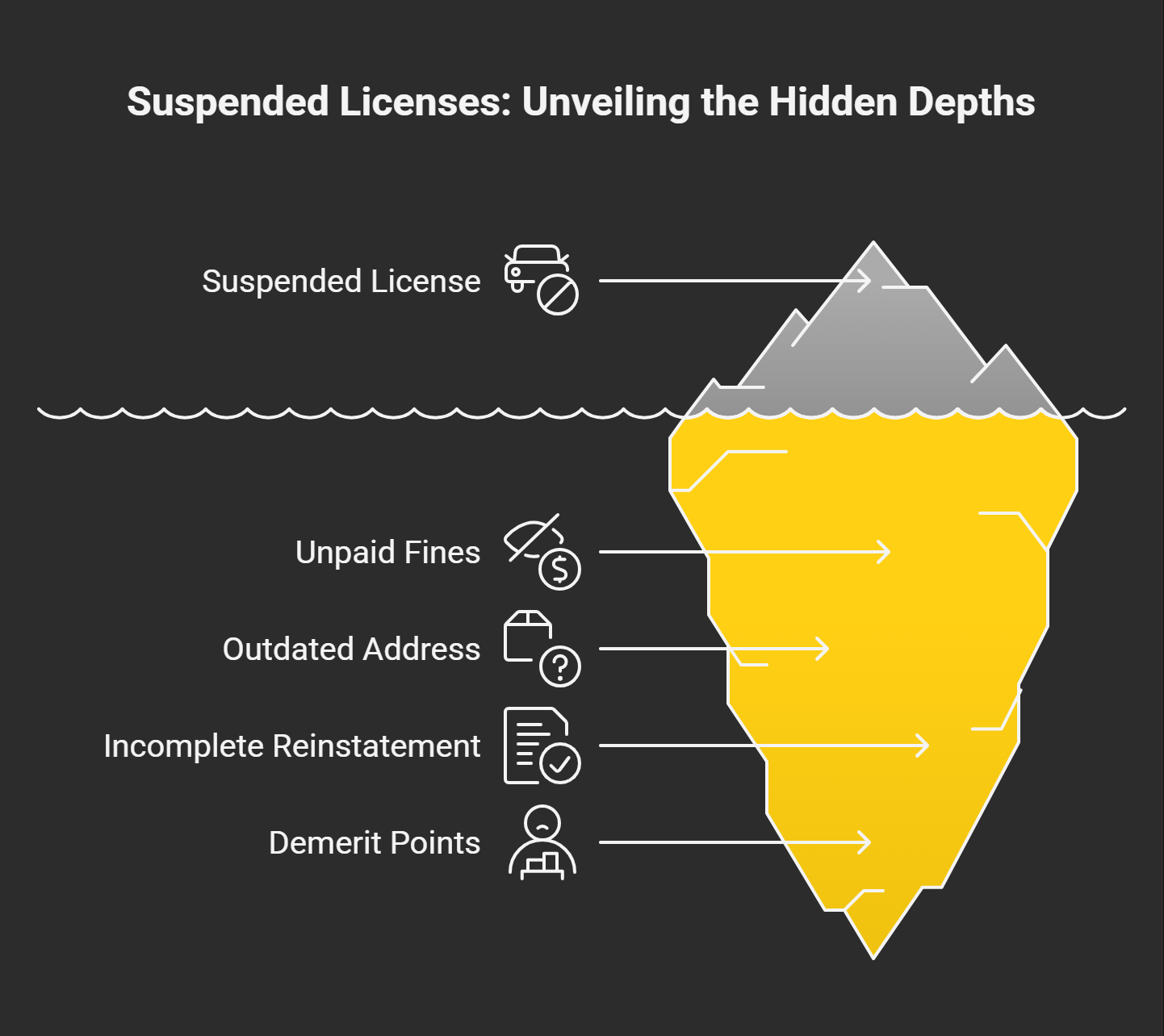
Unpaid fines and defaulted tickets (the biggest one)
Unpaid fines are frequently cited as a top reason licences end up suspended. (XPolice)
A very common pattern looks like this:
You get a ticket → you do nothing (or you intend to deal with it later) → the court reviews it and you can be convicted without you being present → a notice of fine and due date is mailed to the address on file. (City of Mississauga)
If the fine remains unpaid, added fees can apply, the matter may go to collections, and the Ministry of Transportation may suspend your licence (and/or deny plate renewal). (City of Mississauga)
The trap is obvious: if your address on file is outdated, or you miss the mailed notice, you can lose the chance to respond early—and you may not find out until you are already suspended.
“I moved” (or my address wasn’t current)
A lot of “surprise suspensions” are really “surprise mail.” If your licence address is old, your notice may go to the wrong place, and you stay in the dark while deadlines pass. That becomes especially risky with tickets and reinstatement requirements because the system assumes the address on file is reliable.
You paid the fine, but the suspension wasn’t cleared
Another underappreciated scenario is thinking you did enough when you paid the amount you owed. In many cases, getting back on the road requires more than just paying a fine. You may also need to pay a reinstatement fee (commonly listed as $281 in Ontario, though fees can change), and you should confirm the licence is actually reinstated before you drive. (Ontario)
Ontario’s Ombudsman has also flagged that a suspension can turn into a cancellation issue if reinstatement steps (including fees) aren’t completed. (Ombudsman Ontario)
Demerit points (especially for drivers who don’t watch their record)
Some drivers get caught by demerit point thresholds—particularly if they’ve had a cluster of convictions close together. Ontario’s guidance notes that at 15+ demerit points, a fully licensed driver’s licence will be suspended for 30 days. (Ontario)
If you are not actively tracking your record (and your mail is inconsistent), it is possible to miss the warning signs.
What happens when you’re pulled over with a suspended licence
A typical traffic stop becomes a very different interaction the moment the officer runs your driver’s licence and sees “suspended” on the system. At that point, it is no longer about the reason for the stop (speeding, rolling stop, equipment issue). It becomes about operating while prohibited.
Two things matter here:
First, the process can move quickly. Police services note that driving while suspended is treated as a serious matter, and arrests without warrant can be available under certain Highway Traffic Act enforcement provisions for specified offences, including section 53. (Belleville Police Service)
Second, the consequences can start immediately. Depending on the type of suspension, you may be facing towing/impound, immediate costs, and a mandatory court process.
Vehicle impoundment: why it gets expensive fast
Many drivers are shocked that the car can be taken even if the suspension was “just unpaid fines.” Ontario references seven-day vehicle impoundments as part of its approach to suspended driving (in specified situations), and XPolice also describes a Vehicle-Impoundment Program with minimum seven-day impoundments for Highway Traffic Act suspensions, with longer impound periods (e.g., 45 days) for certain Criminal Code-related suspension scenarios. (Ontario)
Either way, the practical reality is the same: towing and storage costs add up quickly, and the registered owner is typically the one left paying. (XPolice)
That also means lending your car to someone “who says they’re fine to drive” can backfire—because the vehicle can still be impounded even if the owner wasn’t driving. (XPolice)
Penalties after a conviction: fines, added suspension, and possible jail
This is where “suspended licence ticket Ontario” stops sounding like a routine traffic matter.
For the common Highway Traffic Act version of the offence, sources consistently describe the fine range as:
First conviction: minimum $1,000 up to $5,000, plus an additional suspension (often described as an additional six months). (XPolice)
Subsequent conviction: minimum $2,000 up to $5,000, with jail up to six months being a possibility in the statutory framing and in commentary. (XPolice)
There are also more serious “driving while suspended” situations that tie into Criminal Code-related suspensions/prohibitions; police materials highlight significantly higher fine ranges in those circumstances, and impoundment periods can be longer. (Belleville Police Service)
Why the problem escalates even if the original issue was “small”
The underlying reason for the suspension is often mundane—an unpaid fine, a missed court response, or paperwork you didn’t keep up with. But once you’re suspended, every additional decision you make can multiply the damage:
If you keep driving, you risk additional charges and longer suspensions. (XPolice)
If the vehicle is impounded, you immediately inherit towing/storage costs and the disruption of being without a car. (XPolice)
If you are convicted, the fines and added suspension can trigger cascading consequences (work disruption, licensing delays, and insurance problems).
Insurance is the quiet multiplier. Licence suspensions are often treated as a serious negative marker by insurers, and some insurance guidance explicitly notes the risk of being pushed into high-risk categories after a suspension. (Easyway Insurance)
If you suspect your licence might be suspended: what to do right now
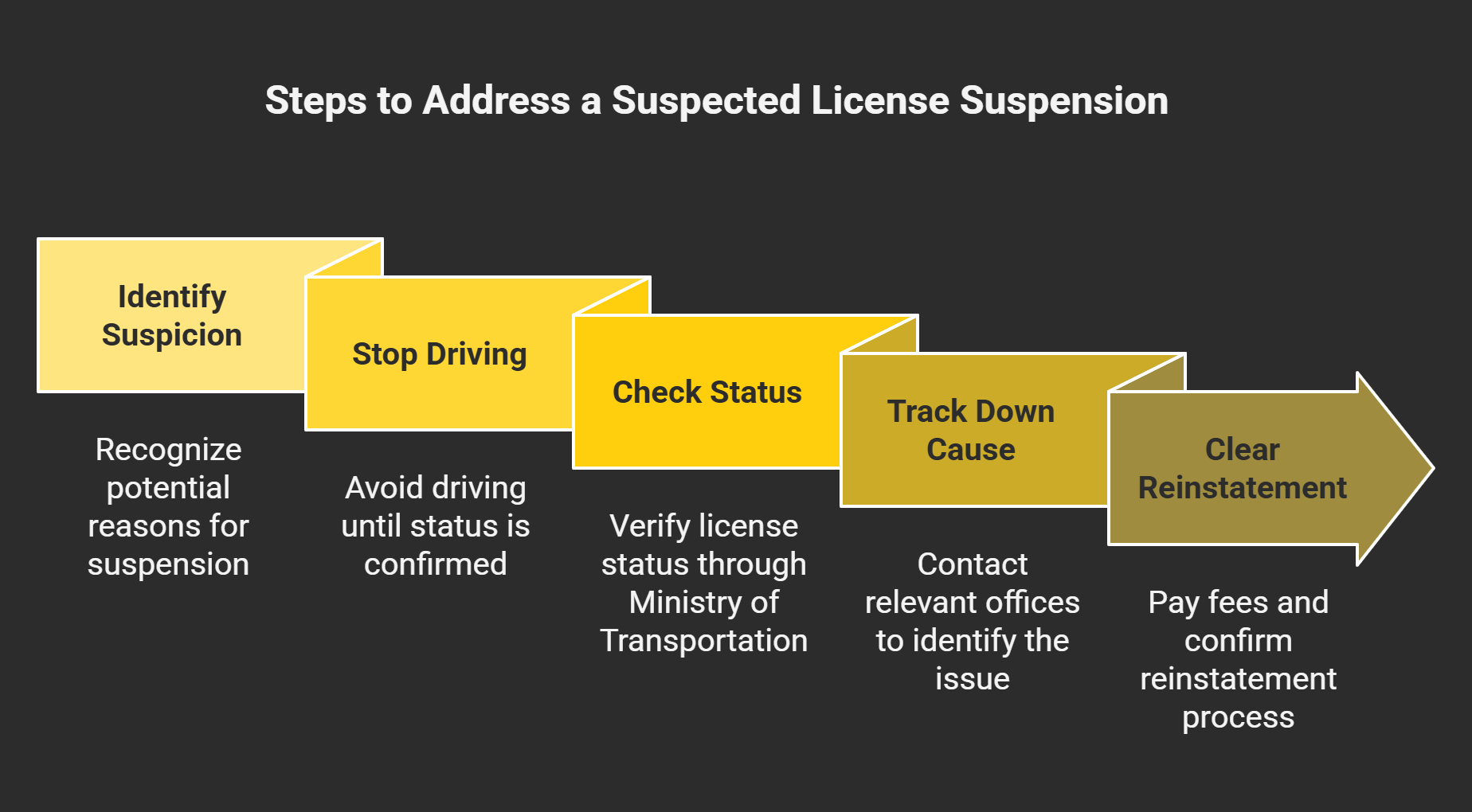
If you have any reason to think you might be suspended—old unpaid tickets, missed mail, a recent demerit-point run, or you were told “there might be a hold on your licence”—treat it like an urgent admin problem.
Step 1: Do not drive until you confirm your status. This is the single simplest way to prevent the situation from getting worse. (XPolice)
Step 2: Check your licence status through the Ministry of Transportation’s driver’s licence check service (it exists specifically so drivers and vehicle owners can verify validity). (City of Mississauga)
Step 3: Track down the cause. If the issue is unpaid fines or a failure to respond, contact the relevant provincial offences office/court listed on your documents, and confirm what is outstanding and what is required to clear it. Municipal court guidance confirms that failing to respond and failing to pay can lead to conviction and suspension/plate renewal denial. (City of Mississauga)
Step 4: Clear reinstatement properly. Paying the fine may not be the end of it. Reinstatement commonly includes a reinstatement fee (often listed as $281), and you should confirm the reinstatement is processed before you drive again. (Ontario)
A note on impoundment appeals (because people ask)
Drivers sometimes assume they can “appeal the tow” the same way they might fight the underlying charge. Ontario’s Licence Appeal Tribunal materials explain that the Tribunal’s jurisdiction is about specific longer impoundments (for example, 45/90/180 days in certain circumstances), and that strict filing deadlines can apply (for example, 15 days is referenced for certain appeals). (Tribunals Ontario)
That is one more reason suspended driving becomes costly quickly: the short-term impoundment is often a built-in consequence, not a negotiable roadside outcome.
How to avoid getting suspended without realizing it
This is the preventive checklist that would eliminate a large portion of “I didn’t even know” cases:
Keep your address current on your licence so notices land where you actually live.
Respond to tickets immediately, even if your choice is to dispute or request early resolution—because “do nothing” can still lead to conviction and mailed fines. (City of Mississauga)
If you pay fines, confirm the suspension is cleared and all reinstatement steps are complete (including any reinstatement fee) before driving. (Ontario)
If you lend your vehicle, verify the driver’s licence status—because impoundment consequences can land on the owner even when the owner wasn’t driving. (XPolice)
Related reading on XPolice.ca
If you’re building a clearer picture of Ontario driving-related charges and how they escalate, these are useful next reads:
Blog home
What Happens If You Ignore a Traffic Ticket in Ontario? (XPolice)
Caught Driving While Suspended? Know the Real Consequences (XPolice)
Driving With a Suspended License Ontario (XPolice)
Caught Driving Without a Licence in Ontario? Here’s What You’re Facing (XPolice)