

March Break is one of those times of year when a “quick road trip” turns into long highway stretches, changing speed limits, and a lot of drivers trying to make good time. If you are travelling across Ontario for a family getaway, visiting friends, or doing a last-minute ski trip, the temptation is predictable: you set the cruise control, you keep up with traffic, and you assume a ticket is “just a fine.”
That logic breaks down fast once you drift into “50 over” territory. In Ontario, the difference between a standard speeding ticket and a stunt driving charge is not just the dollar amount. It is the difference between a manageable Provincial Offences process and a situation that can trigger immediate roadside penalties, major long-term insurance fallout, and a court process you cannot simply “pay away.” (CAA)
This guide covers what matters most for March Break driving: where the line is, what happens at the roadside, the real speeding ticket Ontario consequences, and why paying immediately can backfire if you have not spoken to a licensed paralegal first.
Speeding vs. stunt driving in Ontario: the line that changes everything
Most drivers think of speeding as a single offence: you were over the limit, you get a ticket, you pay it, life goes on. But Ontario treats extreme speed differently, and “stunt driving” is the category that catches people off guard.
In Ontario, stunt driving is not limited to racing. It includes specific speed thresholds and other aggressive driving behaviours. The speed-related triggers that matter most on March Break trips are: driving 40 km/h or more over the limit on roads posted under 80 km/h, driving 50 km/h or more over the limit, and driving 150 km/h or more anywhere in the province (including 110 km/h highways). (CAA)
That is why “stunt driving Ontario 50 km over” is such a common search. Drivers are often stunned to learn that what felt like “one bad moment” can be treated as one of the most serious Highway Traffic Act charges available. (CAA)

“50 over” examples that happen on real March Break drives
Here is how people accidentally cross the line:
On a 400-series highway posted at 110 km/h, a driver doing 150 km/h may assume it is “40 over.” Ontario can still treat 150+ as stunt driving. (CAA)
On a two-lane regional road posted at 70 km/h, a driver at 110 km/h hits the 40-over threshold and can be in stunt driving territory even though they are not “50 over.” (CAA)
On a highway posted at 100 km/h, driving 150 km/h is both 50 over and 150+, which puts you deep into “not a normal speeding ticket” consequences. (CAA)
What happens at the roadside: why this is not a normal ticket
If you are stopped for routine speeding, the interaction is usually straightforward: documents, a ticket, and you are sent on your way.
Stunt driving is different because Ontario uses immediate roadside penalties. According to CAA South Central Ontario’s road safety summary, drivers involved in stunt driving can face an immediate 30-day driver’s licence suspension and an immediate 14-day vehicle impoundment at roadside (even if the vehicle is not yours). (CAA)
This is where March Break gets especially messy. A roadside suspension can strand you hours from home, and an impound can turn a family trip into a towing and storage problem with significant out-of-pocket costs before you even get to court. (CAA)
Speeding ticket Ontario consequences: fines add up, but “court” is the real pivot point
Even when a stop does not become a stunt driving charge, the financial and record consequences of speeding can be larger than most people expect.
Ontario’s set-fine schedule shows that speeding fines scale per kilometre over the limit: $2.50 per kilometre for 1–19 over, $3.75 per kilometre for 20–29 over, and $6.00 per kilometre for 30–49 over. Once you hit 50 km/h or more over, the schedule indicates “no out of court settlement,” meaning it is not designed as a simple pay-and-forget ticket. (Ontario Courts)
That “no out of court settlement” detail is a key reason paying immediately can backfire. If you treat a serious allegation like a routine ticket, you can make irreversible choices before you understand what the process actually requires. (Ontario Courts)
Community safety zones and construction areas can be harsher than people assume
Ontario’s set-fine schedule also shows a separate (higher) fine structure for “community safety zone” speeding, and it becomes restrictive sooner. For example, in the community safety zone schedule, 30–49 km/h over is listed as “no out of court settlement.” (Ontario Courts)
March Break travel often includes unfamiliar towns, weekend construction patterns, and “speed drops” you can miss if you are following traffic. That is exactly when this escalates.
The real “stunt driving” consequences: immediate disruption plus long-term penalties
If the roadside consequences are the immediate shock, the long-term consequences are the slow burn.
CAA’s summary of Ontario stunt driving penalties includes: a minimum fine of $2,000 and a maximum fine of $10,000, six demerit points upon conviction, and the possibility of jail time up to six months. It also notes post-conviction licence suspensions that escalate significantly for repeat convictions (including a minimum one-year suspension on a first conviction). (CAA)
Even if you are ultimately focused on “how much is the fine,” the bigger March Break reality is this: the disruption to your licence and your insurance profile can be the true cost driver, and it can follow you long after the vacation photos are forgotten. (CAA)
If you want deeper reading on how Ontario defines and treats the charge, see XPolice’s overview of what stunt driving can include: Charged with Stunt Driving? Fight Back. (XPolice)
Why paying immediately can backfire (even when you feel “guilty”)
A lot of drivers pay quickly because they want the stress gone. That instinct is understandable, but it is often the wrong move for two reasons: it locks in outcomes, and it can close doors you did not realize you had.
1) Paying is pleading guilty, and that means a conviction
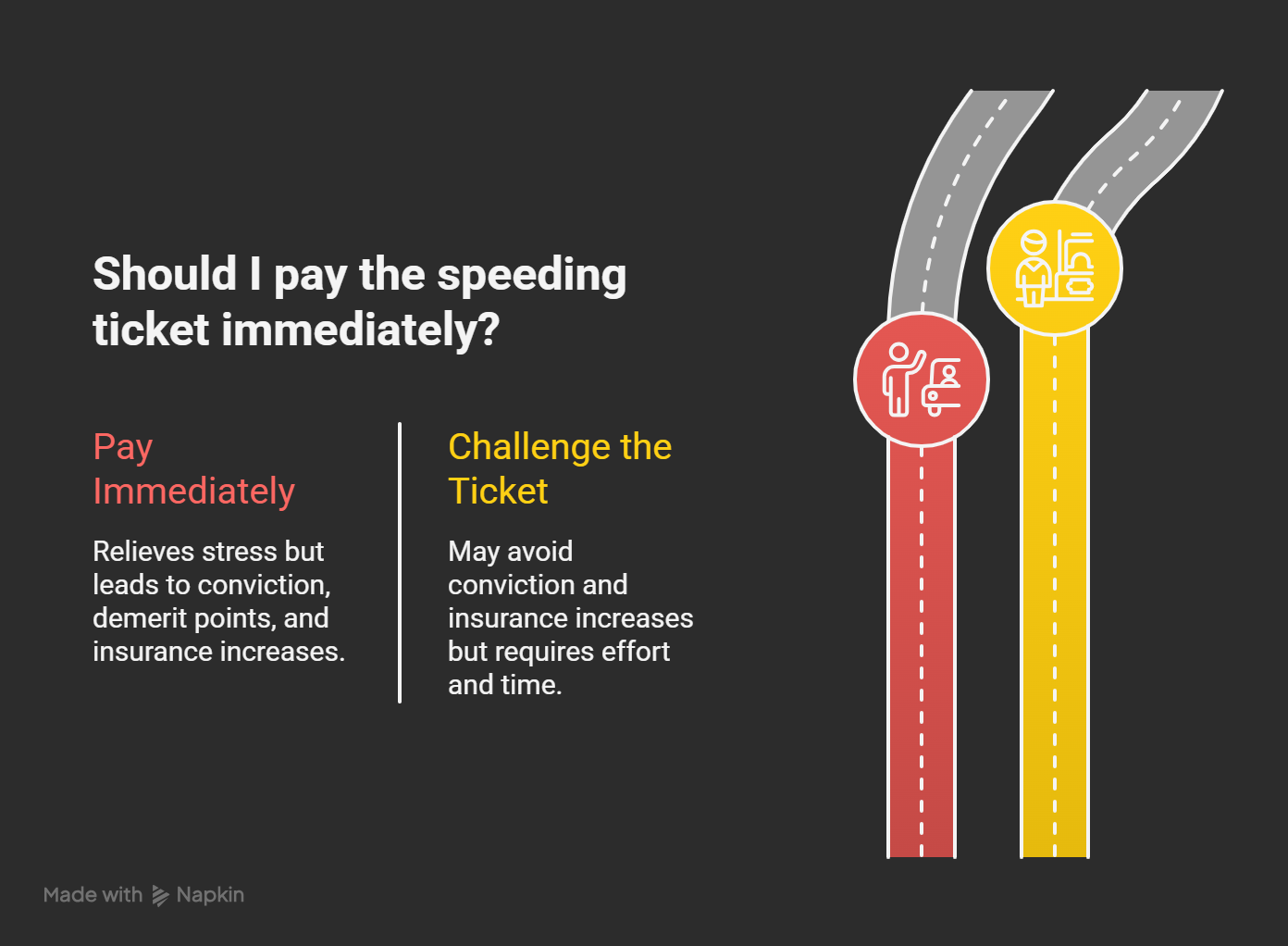
XPolice’s FAQ is blunt about this: if you simply pay the ticket, it is the equivalent of pleading guilty and being convicted, which can lead to demerit points, possible licence suspensions, and insurance increases. (XPolice)
This is also why “speeding ticket Ontario consequences” is not just a question about the fine. A conviction can affect your record and premiums well beyond the initial amount. (XPolice)
2) Some allegations are not meant to be “paid away”
Ontario’s set-fine schedule flags 50 km/h or more over as “no out of court settlement,” which is a strong signal that the process is different at that level. (Ontario Courts)
Separately, XPolice’s resources explain that more serious matters (Part III proceedings) are summons matters where you cannot “just pay it,” and stunt driving is included in that serious category in their overview. (XPolice)
3) Early choices can decide your insurance outcome before you even see the evidence
Insurance companies do not price you based on how apologetic you were roadside. They price you based on convictions and categories of convictions.
XPolice’s insurance-focused guidance notes that even one minor ticket can affect rates for up to three years, and it emphasizes that paying is an admission of guilt that results in a conviction visible to your insurer. (XPolice)
If you want a practical explainer on why the insurance side hits so hard, see: Why Insurance Rates Increase After a Ticket. (XPolice)
What to do instead: a practical post-stop checklist
This is not legal advice, but it is the practical sequence that reduces unforced errors after a March Break stop.
First, do not compound the problem at the roadside. Be polite, comply with requests for documents, and avoid debating the allegation. If you plan to dispute the charge, avoid making “on the record” statements you will regret later.
Second, write down what you remember as soon as you are safe to do so: time, location, posted limit, traffic conditions, weather, and anything notable about the stop. Details fade quickly after a stressful interaction.
Third, do not ignore deadlines. Ignoring a ticket can lead to default conviction and escalating consequences, including administrative problems with licensing and renewal. (XPolice)
Fourth, talk to a licensed paralegal before paying, especially if the allegation is anywhere near stunt driving thresholds. That conversation is about understanding your options and the downstream consequences before you lock in a conviction.
For related reading on avoiding escalation through inaction, see: What Happens If You Ignore a Traffic Ticket in Ontario? (XPolice)
March Break prevention: how to stay out of “50 over” territory without driving like a robot
Most March Break “big tickets” are not intentional. They are fatigue, impatience, and speed-limit transitions.
Use cruise control thoughtfully on long highway runs, but stay alert for speed drops at the edges of towns and interchange zones. Build extra time into the trip so you are not “making up minutes” with speed. Take breaks earlier than you think you need, because fatigue quietly raises risk tolerance.
Most importantly, remember that stunt-driving thresholds are not only “50 over on the highway.” On roads under 80 km/h, 40 km/h over can be enough, and 150 km/h can trigger stunt driving anywhere. (CAA)
Bottom line
March Break travel is exactly when Ontario’s speeding enforcement lines catch normal drivers: long drives, unfamiliar roads, and one lapse that pushes you over a threshold you did not realize mattered.
If you are dealing with a borderline or serious allegation, treat it like a decision with long-term consequences, not a quick fine. Paying immediately can feel efficient, but it can also be the moment you turn a stressful stop into a lasting conviction and insurance problem. (XPolice)
If you want to browse related guides, you can start at the XPolice Blog or review the main service overview at the XPolice homepage.