
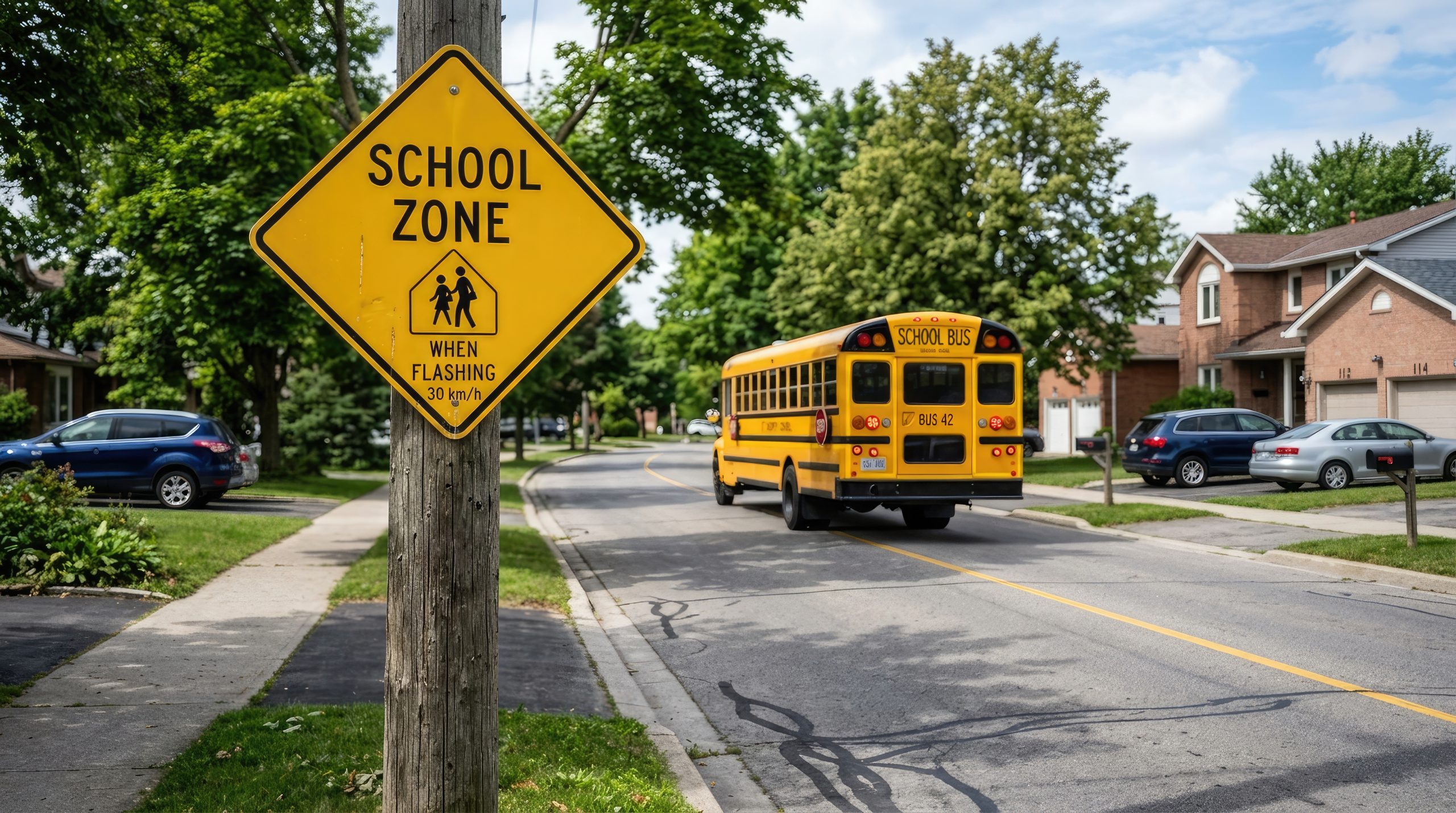
Labour Day is Monday, September 7. Two million children go back to school in Ontario the next morning, and the streets around every one of those schools change character overnight.
Something else changed too, and it did not get nearly enough attention.
This is the first full school year in Ontario with no automated speed enforcement anywhere in the province. The cameras came down. The grey boxes near the schools are gone. And an enormous number of drivers have quietly concluded that the enforcement went with them.
It did not. It changed hands. And the ticket that comes from a pair of hands instead of a lens is worse in every way that matters.
What actually happened to school zone enforcement in Ontario?
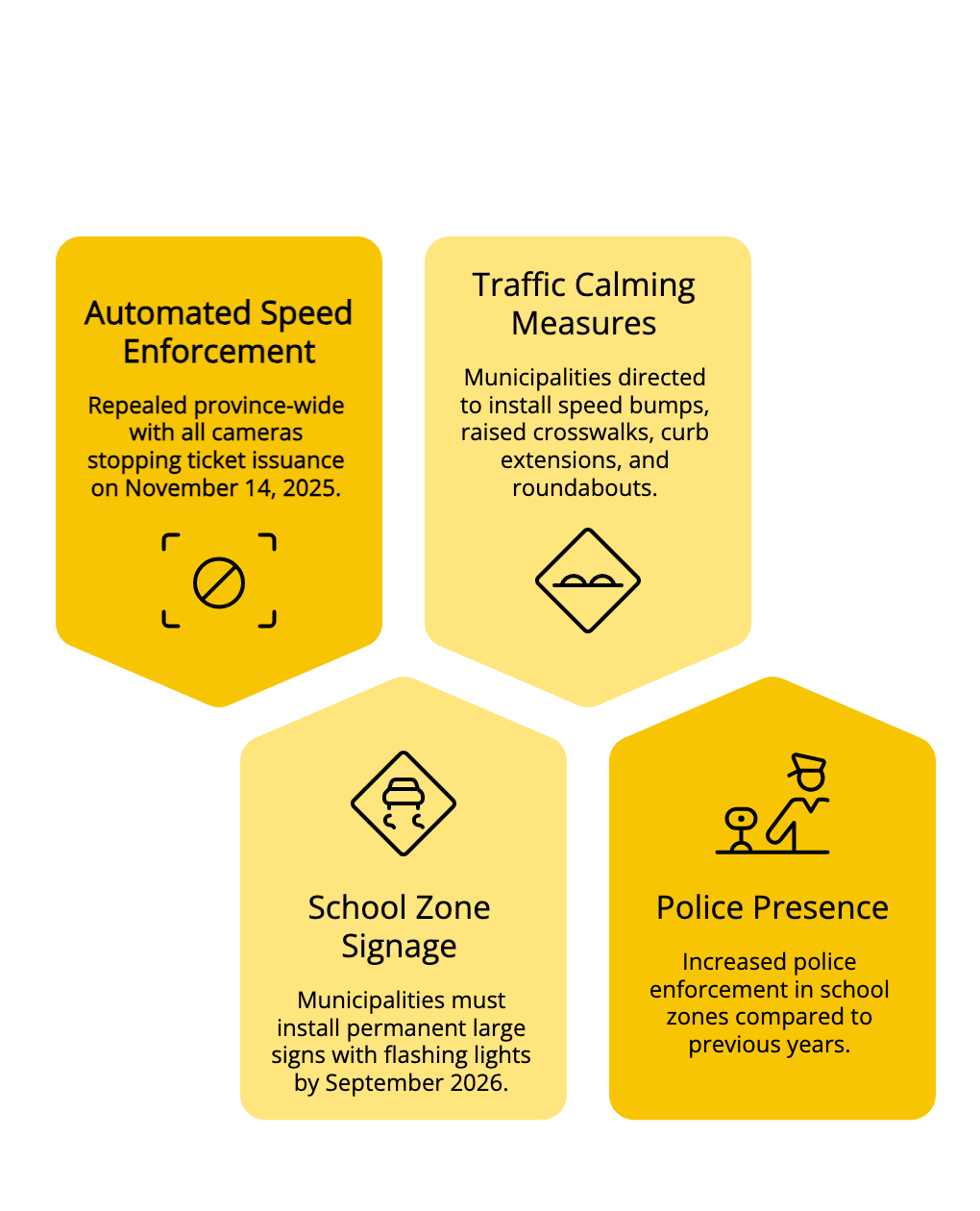
Automated speed enforcement was repealed province-wide and every camera stopped issuing tickets on November 14, 2025. Toronto, Ottawa, Hamilton, Mississauga, Waterloo, London, and the York, Peel, and Durham regions all shut their programs down on the same day.
In their place, the province required municipalities to install new school zone signage, and set a deadline of September 2026 for permanent large signs with flashing lights to be in place at affected school zones. Municipalities were also directed toward traffic calming: speed bumps, raised crosswalks, curb extensions, roundabouts.
So this month, you will see new signs. You will not see cameras.
What you will see, in a way you did not for the last several years, is police.
Why did police enforcement in school zones go up?
Because the zones did not stop existing when the cameras came down, and neither did the reason they were created.
Community safety zones were introduced to protect vulnerable road users. They surround schools, but also hospitals, daycares, playgrounds, parks, and seniors’ residences. They are marked with signs at the beginning and end, and unless the signage says otherwise, they are in effect twenty-four hours a day.
School zone speed limits themselves typically run 30 to 40 km/h, and the hours vary considerably by municipality. Some run 8 a.m. to 5 p.m. on school days. Mississauga and others have expanded to 6 a.m. to 6 p.m. Some zones near parks and community centres are in effect around the clock.
Read the sign. Do not assume you know the hours. The municipality sets them and they are not standardized.
Officers know exactly where the old camera sites were, because those sites were selected using collision and speed data. The cameras identified the problem locations. The province removed the cameras. The locations are still problem locations, and now a human being is standing in them.
Are fines really doubled in a community safety zone?
Yes. Speeding fines in Ontario are calculated per kilometre per hour over the posted limit, and inside a designated community safety zone those fines are doubled. The same doubling applies in construction zones when workers are present.
Add court costs and the victim fine surcharge on top, and a ticket for a moderate amount over the limit in a school zone can land in the several hundred dollar range without much effort.
Here is the part almost every article about this stops at, and here is where they get it wrong.
The doubled fine is not the problem.
Why is the conviction worse than the fine?
Because the fine is a one-time cost and the conviction is not.
Compare what the camera used to do to you with what an officer does to you now.
A speed camera ticket was issued to the registered owner of the vehicle, not to a driver. The camera could not identify who was behind the wheel and did not try. Which meant:
- No demerit points, ever
- Nothing recorded against you as a driver
- Effectively invisible to your insurer in most cases
An officer’s ticket is issued to you. Which means:
- Demerit points apply once you are far enough over the limit
- A conviction goes on your driving record
- Your insurance company finds it at renewal and rates you accordingly
- The premium increase runs for roughly three years
That is the trade Ontario drivers made without being told the terms. The province removed a system that took your money and left your record alone, and replaced it with a system that takes your money, your record, and your insurance rate.
And the demerit points matter enormously in the wrong hands. Speeding 30 to 49 km/h over the limit carries four demerit points. In a 40 km/h school zone, 70 km/h reaches that threshold. For a G1 or G2 driver, a four-point conviction is an automatic 30-day licence suspension regardless of their point total. Our guide to demerit points in Ontario sets out the full thresholds.
At 50 km/h or more over the limit, you are no longer talking about a speeding ticket at all. You are talking about stunt driving, a 30-day roadside suspension, and a 14-day vehicle impoundment. In a 30 km/h school zone, that threshold arrives at 80.
Can a school zone ticket actually be fought?
Yes, and more successfully than most drivers expect, precisely because human enforcement is challengeable enforcement.
A camera produced a photograph, a timestamp, and a calibration record. There was very little to test. An officer’s ticket is built on a chain of decisions, and every link can be examined:
Was the zone properly designated and signed? A community safety zone must be established by municipal by-law and marked with signs at its beginning and end. Was the signage present, visible, and correct on that date?
Were the reduced-speed hours actually in effect? School zone limits apply during posted hours. A ticket written outside those hours, at the reduced limit, is a ticket with a problem.
Was the speed measurement device calibrated and tested? Before the shift and after it. Was the officer trained and certified on that specific device?
Was your vehicle correctly identified? School zones are busy. Tracking history matters.
What do the officer’s notes say? Do they match the certificate of offence?
Was disclosure provided, and was it provided on time?
We wrote about the mechanics of speed measurement and disclosure in our post on Ontario’s school zone speeding laws. The principles have not changed. The enforcement has.
Where is this happening most?
Everywhere with schools, which is everywhere. But the concentration follows the density.
The old automated enforcement programs ran hardest in Toronto, Mississauga, Ottawa, and Hamilton, and those are the municipalities that lost the most coverage when the cameras came down. They are also the municipalities with the most officers available to fill the gap.
If you were stopped in a school zone this fall in any of those jurisdictions, we appear in those courts.
What to do with the ticket
Do not pay it. Paying the fine is a plea of guilty and it registers a conviction. It is the single most expensive mistake available to you on a piece of paper designed to make it feel like the responsible choice.
Count fifteen days. Calendar days, from the date of service. Weekends and holidays count.
Read the ticket carefully. The speed alleged, the posted limit, the zone, the time of day. Those four facts determine everything.
Call before you decide anything.
How XPolice can help
XPolice has been defending Ontario drivers since 2003. Our team is licensed paralegals and former police officers with more than 120 years of combined experience, which means the people reviewing your file have written these tickets and know what the file behind one is supposed to contain.
Most firms will take your school zone ticket to a prosecutor, negotiate it down a few kilometres per hour, and call that a victory. Then your insurance renewal arrives and nothing has changed, because your insurer rates convictions, not demerit points.
We are not just interested in reducing your charges. Our goal is to beat them. A withdrawn charge leaves your record exactly as it was. That is the only outcome that protects your premium.
We go to court for you so that you do not have to. See how we approach speeding ticket defence across Ontario.
Call before you pay. 1-888-XPOLICE (1-888-976-5423). Free consultation, no obligation.
Frequently Asked Questions
Are speeding fines really doubled in Ontario school zones?
Fines are doubled inside a designated community safety zone, and most school zones are designated as community safety zones. The doubling also applies in construction zones when workers are present. The fine is not the main cost, though. The conviction goes on your driving record, carries demerit points, and raises your insurance premium for roughly three years, which typically costs many times the ticket itself.
Do speed cameras still operate in Ontario school zones?
No. Automated speed enforcement ended province-wide on November 14, 2025 and no municipality operates speed cameras anywhere in Ontario. The province required new school zone signage in their place, including permanent flashing signs due by September 2026. Enforcement in these zones is now carried out by police officers, and an officer’s ticket carries demerit points that a camera ticket never could.
Can I fight a school zone speeding ticket?
Yes. Because enforcement is now conducted by officers rather than cameras, there is considerably more to examine: whether the community safety zone was properly designated and signed, whether the reduced-speed hours were in effect at the time, whether the speed measurement device was calibrated and the officer certified on it, and whether disclosure was provided properly. Contact us for a free review of your ticket.