The road opens up somewhere past the Barrie exits. Traffic thins out. The lake is ninety minutes ahead, the car is comfortable, and you are moving with everybody else in the left lane.
Then the cruiser is behind you, and the officer says a number out loud, and it is 145.
Within twenty minutes you are standing on the shoulder of Highway 400 watching a tow truck take your car. Your licence is in the officer’s pocket. There is no ticket to argue about later. It has already happened.
Nobody plans this. The overwhelming majority of drivers charged with stunt driving in Ontario have never had a serious ticket in their lives. They are not racing anyone. They are going to the cottage. And they are about to discover that Ontario’s stunt driving law does not have a category for people like them.
What actually counts as stunt driving in Ontario?
Stunt driving is set out in section 172 of the Highway Traffic Act, with the specific behaviours defined in O. Reg. 455/07. Despite the name, most people charged with it were not doing a stunt. They were speeding.
You can be charged with stunt driving if you are:
- Driving 40 km/h or more over the limit where the posted limit is less than 80 km/h
- Driving 50 km/h or more over the limit where the posted limit is 80 km/h or higher
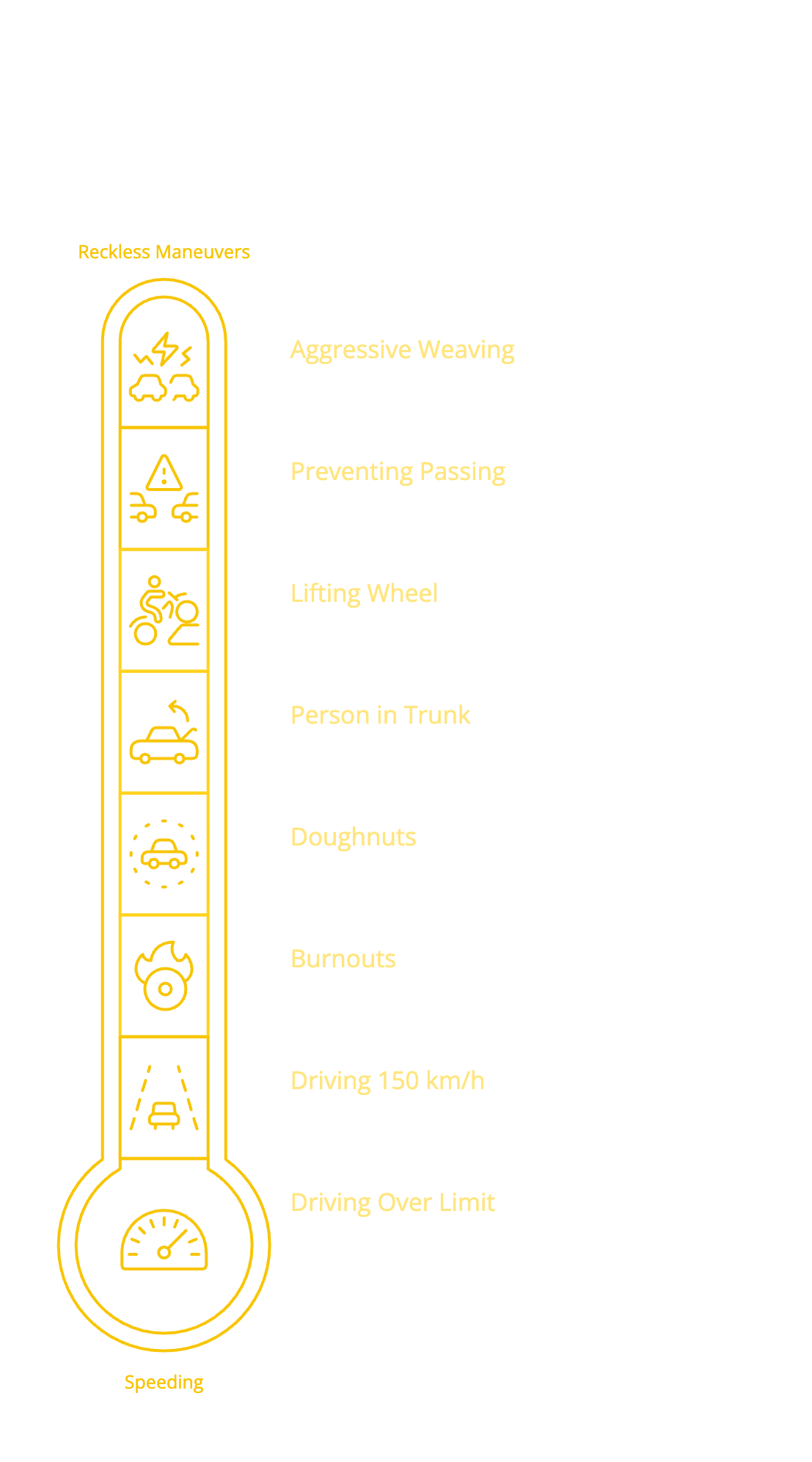
- Driving 150 km/h or more, anywhere in the province, including on freeway sections posted at 110 km/h
That last one deserves a second read. On a 110 zone, you reach the stunt driving threshold at 150. That is 40 over on a highway built for speed, on a clear July afternoon, in a car that does not feel like it is working hard.
The regulation also captures conduct that has nothing to do with speed: burnouts, doughnuts, driving with a person in the trunk, lifting a wheel off the pavement, preventing another vehicle from passing, and weaving aggressively through traffic. But speed is what puts most Ontario drivers in front of a justice of the peace.
What happens at the roadside, before any court sees your case?
This is what separates stunt driving from every other traffic charge. The penalties do not wait for a conviction. They start on the shoulder of the highway.
At the roadside, on the charge alone:
- Your driver’s licence is suspended for 30 days. Immediately.
- Your vehicle is impounded for 14 days. Immediately.
- You pay the towing and the storage. Those costs are yours regardless of what happens in court.
- You are getting home some other way. If the car was full of family, so is that problem.
- You have not been convicted of anything. You have not seen a courtroom. A charge alone triggered all of it, and none of it is reversible after the fact.
And you will not receive an ordinary yellow offence notice. Stunt driving comes with a summons, which means you or your legal representative are required to appear in court on a specified date. There is no fine you can quietly pay to make it go away.
What changed on January 1, 2026?
A great deal, and it went almost unreported.
Ontario brought a package of Highway Traffic Act amendments into force on January 1, 2026 under the Safer Roads and Communities Act.
For stunt driving, the key change is this:
A minimum post-conviction licence suspension now applies automatically once a conviction is entered. No separate court order is required.
Previously there was procedural room. A conviction did not always translate cleanly and immediately into the post-conviction suspension. That gap has been closed. Convicted means suspended, by default, with far less discretion in how the minimum applies.
Stack that on top of the penalties a conviction already carried:
- A fine ranging from $2,000 to $10,000, plus a victim fine surcharge
- Six demerit points
- Possible jail time of up to six months
- A post-conviction licence suspension starting at a minimum of one year for a first conviction and escalating sharply for subsequent convictions
- A mandatory driver improvement course that must be completed before your licence comes back
Read that list again and notice that the 30-day roadside suspension you already served does not count toward any of it.

Why is getting the charge reduced not actually a win?
Here is where most of the traffic ticket industry quietly fails its clients.
The standard playbook is to walk into court, speak to the prosecutor, and negotiate stunt driving down to a speeding charge. The client keeps their licence, the demerit points shrink, everyone shakes hands, and the invoice goes out. It looks like a victory.
Then the insurance renewal arrives.
A conviction is a conviction. Your insurer does not read the transcript. It reads your driving abstract, and a speeding conviction of any size on that abstract changes what you pay. A large one changes it dramatically. Drivers pushed out of the standard market and into the high-risk market can see their premiums multiply, and those elevated rates persist for years.
The fine is a one-time payment. The insurance is a bleed that runs for three years and sometimes longer.
We are not just interested in reducing your charges. Our goal is to beat it. A withdrawn charge leaves nothing on your abstract. A reduced charge leaves something on it forever, and your insurer will find it.
If you are trying to understand what a conviction will actually do to your premium, our page on insurance disputes explains how insurers classify traffic convictions and what that classification costs.
Why does this happen so often on the 400 corridor in July?
Because everything lines up.
The 400 and the 11 carry an enormous volume of cottage traffic from late June through Labour Day. The road is straight, the surface is good, and after the Barrie split the traffic drops off enough that speed stops feeling like speed. Drivers who have been sitting in stop-and-go through the GTA finally get moving and do not stop getting faster.
The OPP knows all of this. Enforcement is deliberate, concentrated, and it is not a secret. The stretches through Simcoe County, Muskoka, and north of the Highway 9 interchange are worked hard all summer.
We defend drivers charged across this corridor. If you were stopped on the 400, our Barrie office handles the courts in that jurisdiction. If you were stopped further south, on Highway 404 or through Newmarket and Aurora, our York Region office covers those matters.
We also wrote about how these charges arise in our post on summer road trip and cottage country tickets, which is worth reading before your next drive north.
Can a stunt driving charge actually be beaten?
Yes, and it is beaten far more often than most drivers assume.
Stunt driving is not a criminal offence in Ontario. It is prosecuted under provincial law, which means the Crown still has to prove its case, and the case rests on evidence that can be tested. When we review a stunt driving file, we look at:
How the speed was measured. Radar and lidar devices require testing and calibration. Was the device tested at the start and end of the shift? Was the officer certified on that device?
Whether your vehicle was correctly identified. On a busy highway, tracking history matters. Was your car isolated from surrounding traffic, or was it caught in a pack?
The officer’s notes. What was recorded at the time, and does it match the sworn information?
Disclosure. You are entitled to the Crown’s evidence. What was provided, what was missing, and when did it arrive?
Delay. Court matters must proceed within a reasonable time. Stunt driving matters frequently do not.
The stop itself. Why were you pulled over, and was there lawful authority to do what followed?
Our team includes former police officers with decades of enforcement experience. They know what a properly built file looks like. They also know exactly what a rushed one looks like, and on a busy long weekend, files get rushed.
The Bottom Line
A stunt driving charge in Ontario punishes you before anyone decides whether you did anything wrong. The car is gone for 14 days, the licence is gone for 30, and as of January 2026 a conviction means a suspension applies automatically.
You cannot undo the roadside penalties. You can still protect everything that comes after them.
How Xpolice can help
Xpolice has been defending Ontario drivers since 2003. Our team combines licensed paralegals with former police officers and well over a century of combined experience. We handle the summons, we handle the disclosure, we handle the prosecutor, and we go to court so that you do not have to.
We do not treat a reduction as a finish line. On a charge this serious, the difference between a reduced conviction and no conviction is measured in tens of thousands of dollars over the following three years. Learn how we approach stunt driving defence and what to expect from the process.
Call before you pay. 1-888-XPOLICE (1-888-976-5423). Free consultation, no obligation.
Frequently Asked Questions
Is stunt driving a criminal offence in Ontario?
No. Stunt driving is charged under section 172 of the Highway Traffic Act, which is provincial law, not the Criminal Code. It will not give you a criminal record. That said, the consequences are severe: a conviction can bring fines from $2,000 to $10,000, six demerit points, possible jail time, a mandatory driver improvement course, and a licence suspension that now applies automatically upon conviction.
Can I get my car back before the 14 days are up?
No. The 14-day impoundment and the 30-day roadside licence suspension are administrative penalties triggered by the charge itself, not by a conviction, and they are not reversed by fighting the charge afterward. You are also responsible for the towing and storage costs. What you can still protect is your licence, your record, and your insurance rate going forward.
How fast do you have to be going to be charged with stunt driving?
40 km/h or more over the limit where the posted limit is under 80 km/h, 50 km/h or more over where the posted limit is 80 km/h or higher, or 150 km/h or more anywhere in Ontario. On a 110 km/h highway you cross the threshold at 150. Speed is not the only way to be charged, but it is by far the most common.