

The ticket says $250-something. There is a website printed on the back. It takes four minutes and a credit card.
Every part of that experience is designed to make paying feel like the sensible, adult, get-it-over-with option. It looks like a parking fee with extra steps.
It is not a fee. It is a guilty plea, and the fine is the cheapest thing attached to it.
What follows is the arithmetic nobody runs before they click pay. Not the scary version. The actual version, with the assumptions written down, so you can put your own numbers into it and decide for yourself.
What are you actually agreeing to when you pay a ticket?
Under section 8 of the Provincial Offences Act, paying the fine on an offence notice is a plea of guilty. A conviction is registered against you.
That conviction does three things:
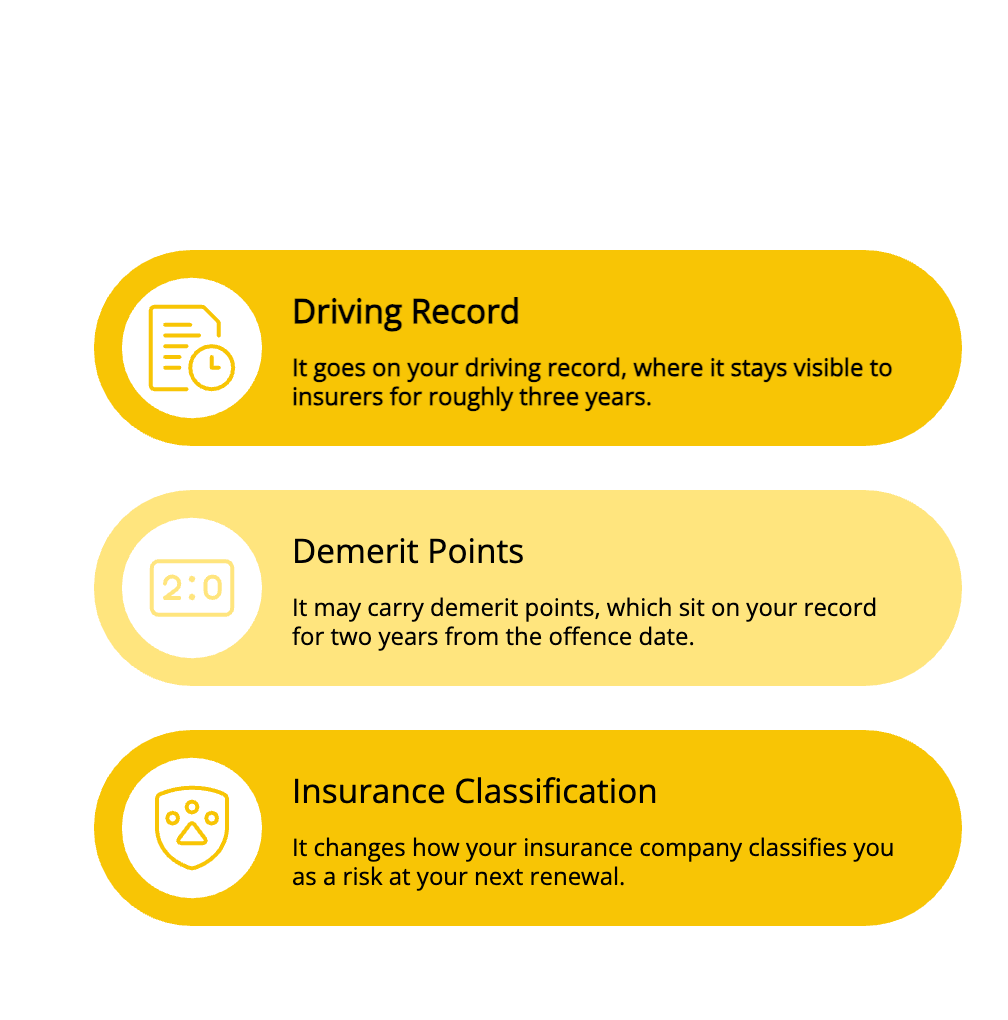
- It goes on your driving record, where it stays visible to insurers for roughly three years.
- It may carry demerit points, which sit on your record for two years from the offence date.
- It changes how your insurance company classifies you as a risk at your next renewal.
Notice that those are three separate clocks and they run at different speeds. Drivers routinely believe that when their demerit points expire, the whole thing is over. It is not. The points are the Ministry’s business. The conviction is your insurer’s business, and the insurer’s clock runs longer. Our guide to demerit points in Ontario sets out the thresholds in full.
Here is the sentence that surprises people most: demerit points do not raise your insurance premium. Insurers do not price off your point total. They price off your convictions. Which is why getting a charge “reduced” to something with fewer points is not the win it is sold as. A reduced conviction is still a conviction, and your insurer will see it and rate it accordingly.
How do Ontario insurers classify convictions?
Most Ontario insurers sort traffic convictions into three tiers. The exact list varies by company, and this is worth confirming with your own broker, but the shape is consistent across the market.
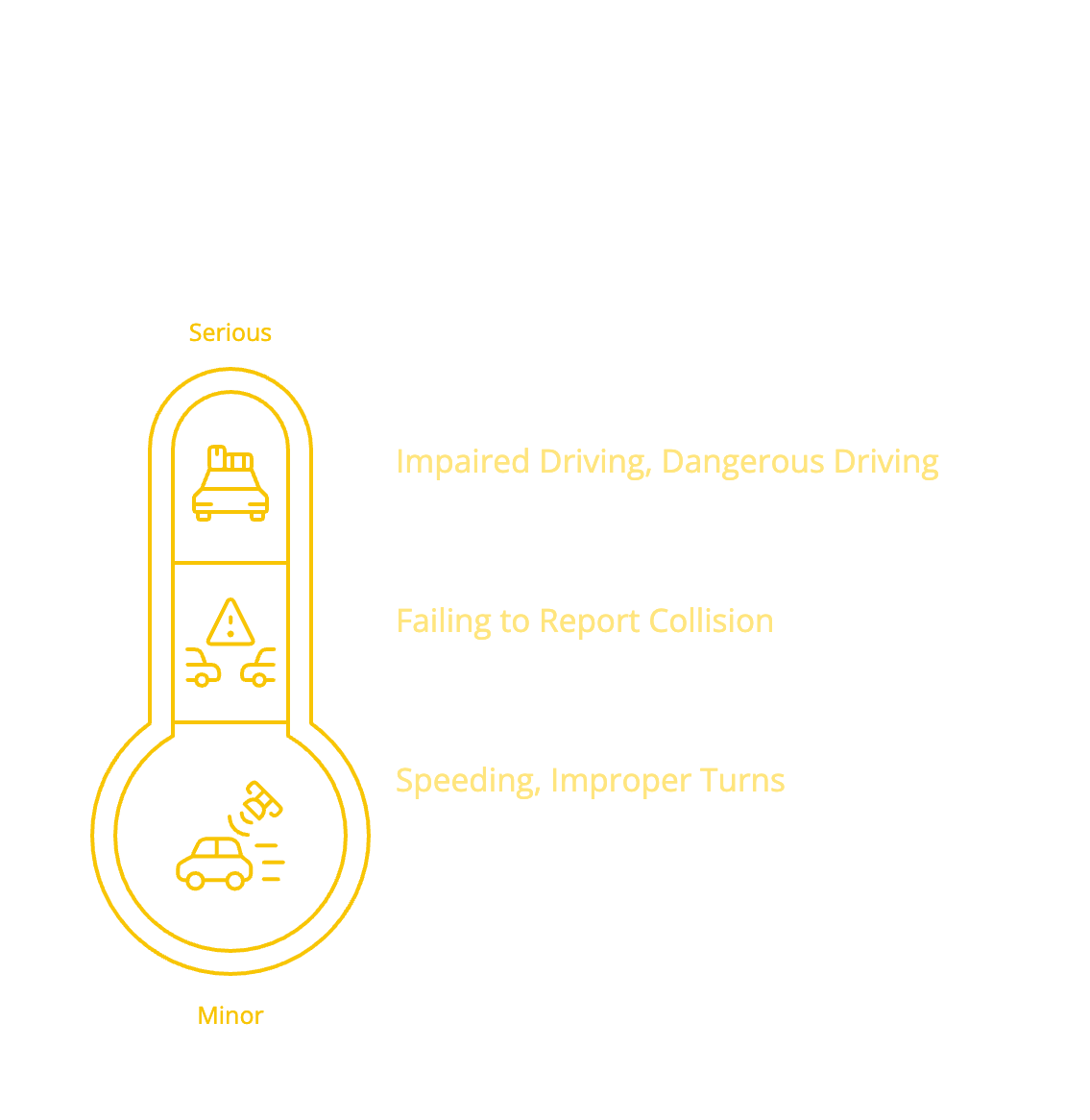
Minor convictions. Most speeding, failing to obey a sign, improper turns, seatbelt offences. One minor conviction is often forgiven or lightly rated by some insurers. A second one is not.
Major convictions. Failing to report a collision, driving without insurance, improper passing of a school bus. Some insurers classify careless driving here. Others classify it as serious. That distinction alone can be worth thousands.
Serious and criminal convictions. Impaired driving, dangerous driving, racing and stunt driving, failing to remain, driving under suspension. These frequently end the conversation with your existing insurer entirely.
The tier your conviction lands in is the single largest factor in what happens to your premium. And you do not choose the tier. The charge on the ticket does.
The math, with the assumptions written down
Let us take a driver with a clean record paying $2,000 a year for auto insurance. That is our starting point, and your number will differ based on your age, your postal code, your vehicle, and your history.
Scenario one: one minor conviction, first one in years.
Some insurers forgive a single minor. Others apply a surcharge in the range of 10 to 25 percent. Say 15 percent.
- Extra premium: roughly $300 per year
- Over three years: roughly $900
- Plus the $250 fine
- Total cost of “just paying it”: around $1,150
You paid $250 to avoid an argument. It cost you four and a half times that.
Scenario two: a second minor conviction while the first is still on your record.
Forgiveness is gone. Surcharges compound rather than replace each other, and you have now told your insurer that the first one was not a fluke. Increases of 25 to 50 percent are common at this stage.
- Extra premium: roughly $500 to $1,000 per year
- Over three years: roughly $1,500 to $3,000
Scenario three: a conviction that moves you out of the standard market.
This is where the headline number comes from. A serious conviction, or an accumulation your insurer will not accept, means non-renewal. You go looking for coverage and you find it in the high-risk market, sometimes through the Facility Association, at a premium that does not resemble what you used to pay.
A driver at $2,000 who is rerated at $4,000 is paying an extra $2,000 a year.
- Extra premium: $2,000 per year
- Over three years: $6,000
- On a ticket with a $250 fine printed on it
That is the entire thesis of this article. The fine is a rounding error. The conviction is the cost.
These figures are illustrative. Rating varies significantly by insurer, driver profile, region, and vehicle. The point is not the exact number. The point is the ratio.
Why is a reduction not the same as a win?
Because your insurance company is not reading the transcript. It is reading your abstract.
This is where a great deal of the traffic ticket industry quietly underserves its clients. The standard playbook is to walk into court, ask the prosecutor to reduce the charge, take a plea to something smaller, and report back that the demerit points are gone. The client is delighted. The invoice goes out.
Then the renewal arrives, and the premium has moved anyway, because there is still a conviction sitting on the abstract where there used to be nothing.
We are not just interested in reducing your charges. Our goal is to beat them.
A withdrawn charge leaves your record exactly as it was. A dismissed charge leaves your record exactly as it was. A reduced charge leaves a conviction, and your insurer treats a conviction as a conviction. The difference between those two outcomes, on the numbers above, is measured in thousands of dollars over three years.
That is not a slogan. It is the reason the strategy on your file matters more than the size of the fine.
What if your premium already went up?
You have options, and most drivers do not know it.
Insurers make mistakes. Convictions get attributed to the wrong driver on a policy. Records get misread. A charge that was withdrawn shows up as a conviction. An at-fault determination gets made on facts that do not support it. A driver gets rated as high risk on the strength of something that should never have been on their abstract at all.
If your rate moved and you cannot get a straight answer about why, our page on insurance disputes explains what can be done and how the process works.
What should you do with the ticket in your hand?
Do not pay it. Not today. Paying is pleading guilty, and you cannot un-plead.
Count the days. You have 15 calendar days from service to select one of the three options on the back. Weekends and holidays count.
Do the arithmetic above with your own premium. Take your annual premium. Add 15 percent. Multiply by three. Compare that number to the cost of having someone fight the charge properly.
For most Ontario drivers, that comparison is not close.
How XPolice can help
We have been fighting traffic tickets in Ontario since 2003. Our team is licensed paralegals and former police officers with more than 120 years of combined experience, which means the people reviewing your file know how it was built, because some of us used to build them.
We request disclosure. We test the evidence. We deal with the prosecutor. We go to court so that you do not have to take a day off work to stand in a hallway waiting for your name to be called.
And we do not treat a reduction as a finish line, because your insurance company does not either. Whether it is a speeding ticket, a careless driving charge, or something more serious, the goal is the same: nothing new on your abstract.
Pay us a little, or pay your insurance a lot. That is not a marketing line. It is the arithmetic on this page.
Call before you pay. 1-888-XPOLICE (1-888-976-5423). Free consultation, no obligation.
Contact us and find out what your ticket is really going to cost you.
Frequently Asked Questions
How much does a speeding ticket increase insurance in Ontario?
It depends on the conviction tier, your insurer, and your record. A single minor conviction commonly adds somewhere in the range of 10 to 25 percent to your premium, and it stays visible to insurers for about three years. A serious conviction can result in non-renewal and a move into the high-risk market, where premiums can double or worse. On a typical policy, that can mean thousands of dollars on a ticket with a fine of a few hundred.
Do demerit points raise my car insurance?
No, not directly. Insurance companies rate you on convictions, not on your demerit point total. That is why reducing a charge to one with fewer demerit points does not protect your premium. The conviction is still on your driving record and your insurer still sees it. The only outcome that protects your premium is no conviction at all.
How long does a traffic conviction stay on my record in Ontario?
Demerit points remain for two years from the date of the offence. Convictions generally remain visible to insurance companies for about three years from the date of conviction. Those are two different clocks, and the insurance clock is the one that costs you money. Serious convictions can affect your insurability well beyond three years.