

You noticed it a while back. That grey box on the pole near the school, the one you slowed down for every single morning without thinking about it, is not there anymore. Neither is the sign warning you it was coming. The cameras came down across Ontario and nobody sent you a memo about what replaced them.
Then last Tuesday you got pulled over three blocks from that same school. Same street. Same speed you have been doing for years.
Here is the part almost nobody understands, and it is the part that is going to cost you real money: the ticket you just received is significantly worse than anything that camera ever could have sent you. Not because the fine is bigger. Because of what comes attached to it.
Let us walk through exactly what changed, what did not, and why the officer’s ticket in your glove box deserves a fight that a camera ticket never did.
Are speed cameras still used in Ontario?
No. Automated speed enforcement was repealed province-wide and the cameras stopped issuing tickets on November 14, 2025.
The change came through provincial legislation that removed the authority municipalities had been given back in 2017 to operate speed cameras in school zones and community safety zones. Premier Doug Ford described the program as a cash grab. Municipalities, including Toronto, Ottawa, Hamilton, Waterloo, Mississauga, and the York, Peel, and Durham regions, all had to shut their programs down.
Every camera in the province went dark on the same day.
In their place, the province required municipalities to install new school zone signage, with permanent large signs featuring flashing lights due to be in place by September 2026. Cities were also encouraged to lean on traffic-calming measures instead: speed bumps, raised crosswalks, curb extensions, roundabouts.
Signs and speed bumps do not write tickets. Officers do. And that is precisely what has happened.

I got a camera ticket before the ban. Do I still have to deal with it?
Yes. This trips people up constantly.
The ban ended the program going forward. It did not erase the tickets that were already issued. If a camera ticket was served on you before November 14, 2025, it is still a live charge. You still have to respond to it, and doing nothing still results in a conviction being registered against you.
You also still have the right to dispute it. The same options are printed on the back of that offence notice as any other ticket. If you have one sitting in a drawer because you assumed the ban made it disappear, that assumption is about to get expensive.
Why is an officer’s ticket so much worse than a camera ticket?
This is the whole point, and it is the thing that should change how you feel about the ticket you are holding right now.
A speed camera ticket in Ontario was issued to the registered owner of the vehicle. Not the driver. The system had no idea who was behind the wheel, and it did not try to find out. That single design detail had enormous consequences:
- No demerit points. Ever. The camera could not assign points because it could not identify a driver.
- Nothing on your driving record as a driver. The conviction attached to the plate, not to you.
- Effectively invisible to your insurer in most cases, because insurers price your policy off your driving record.
Now compare that to the ticket an officer handed you last Tuesday:
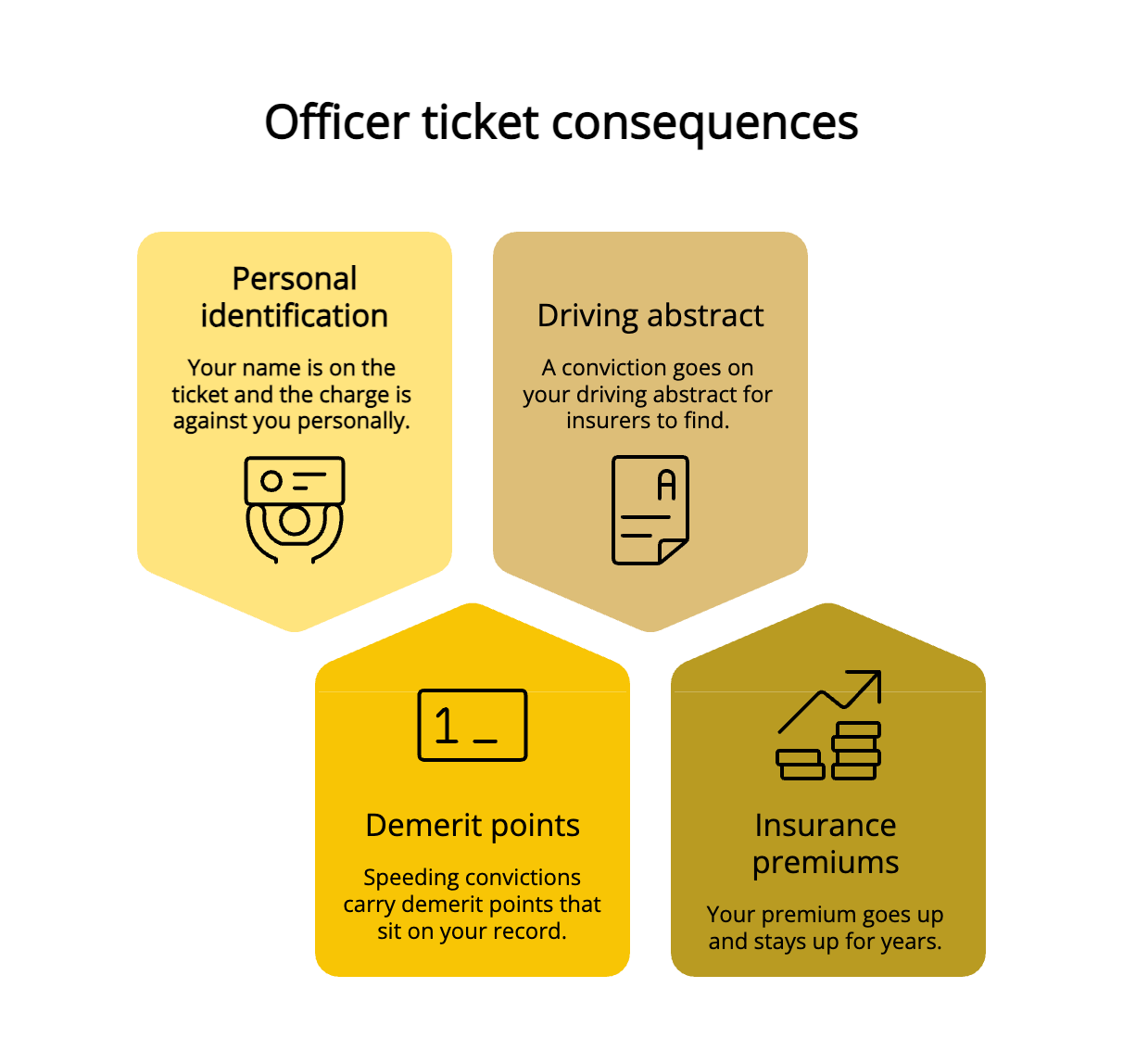
- Your name is on it. You were identified, your licence was run, and the charge is against you personally.
- Demerit points apply. Speeding convictions in Ontario carry demerit points once you are far enough over the limit, and those points sit on your record.
- A conviction goes on your driving abstract, where your insurance company will find it at renewal.
- Your premium goes up, and it stays up. Not for a month. For years.
That is the trade nobody explained when the cameras came down. Drivers got rid of a system that took their money and left their record alone. They replaced it with a system that takes their money and their record and their insurance rate.
If you want to understand exactly how points accumulate and what it takes to trigger a suspension, our guide to demerit points in Ontario breaks the thresholds down.
Where are officers actually enforcing this summer?
Everywhere the cameras used to be, and everywhere the summer sends people.
School and community safety zones. These zones did not stop existing when the cameras came down. Fines inside a designated community safety zone are doubled. Officers know exactly where the old camera locations were, because those sites were chosen for a reason.
Construction zones. Fines are doubled when workers are present, and Ontario’s construction season is compressed into these few months. We covered this in detail in our post on construction zone speeding tickets.
The 400-series highways. Open pavement, light traffic, cottage-bound drivers who are running late. Enforcement follows the volume.
Residential streets and school zones in the fall. With Labour Day and the return to class, expect concentrated enforcement in exactly the areas that once had automated coverage.
A camera never argued back. An officer can be cross-examined.
Here is the flip side, and it is the reason this post exists.
A speed camera produced a photograph, a timestamp, and a calibration certificate. There was very little to challenge. The machine did not have a bad day, did not misremember, and did not cut a corner on its notes.
An officer’s ticket is built on a chain of human decisions, and every link in that chain can be tested. When we take on a speeding file, the questions we ask include:
- Was the speed measurement device properly calibrated and tested, before and after the shift?
- Was the officer trained and certified on that specific device?
- What do the officer’s notes actually say, and do they match the certificate of offence?
- Was your vehicle correctly identified, or was it tracked in a group of vehicles?
- Was the community safety zone or construction zone properly signed and designated on that date?
- Was disclosure provided in full, and was it provided on time?
- Has the matter taken so long to reach trial that your right to be tried within a reasonable time has been compromised?
None of those questions apply to a camera. All of them apply to the ticket in your hand.
That is the shift the ban created. Enforcement in Ontario is now entirely human. Human enforcement is challengeable enforcement.
What should you do with the ticket right now?
Three things, in this order.
Do not pay it. Paying the fine is a plea of guilty. It registers a conviction. It is the single most common and most expensive mistake Ontario drivers make, and the ticket is designed to make it feel like the easy option.
Check the date. You have 15 calendar days from service to respond. Weekends and holidays count.
Call before you decide anything. A consultation costs nothing and takes a few minutes.
How Xpolice can help
We have been fighting traffic tickets in Ontario since 2003. Our team is built from licensed paralegals and former police officers, which means the people reviewing your file have sat on both sides of that traffic stop. We know what an officer’s notebook is supposed to contain. We know what disclosure should look like. We know when a stop was clean and when it was not.
Most firms will get your speeding charge reduced, tell you the points are gone, and send you an invoice. We are not just interested in reducing your charge. Our goal is to beat it, because a reduced conviction is still a conviction, and your insurance company treats it accordingly.
We go to court for you so that you do not have to. Learn more about why drivers choose xpolice, or see how we approach speeding ticket defence across the province.
Call before you pay. 1-888-XPOLICE (1-888-976-5423). Free consultation, no obligation.
Frequently Asked Questions
Do I still have to pay a speed camera ticket I received before the ban?
Yes. Tickets issued before automated speed enforcement ended on November 14, 2025 remain valid charges. You must either pay them or dispute them. Ignoring the ticket results in a conviction being registered and the fine going into default, which brings its own consequences.
Did speed camera tickets give demerit points?
No. Automated speed enforcement tickets were issued to the registered owner of the vehicle rather than to an identified driver, so no demerit points could be applied and the conviction did not attach to your driver’s record. A ticket issued by a police officer is different in every one of those respects.
Is it worth fighting a speeding ticket now that officers are doing the enforcement?
It is more worth it than it ever was. An officer’s ticket carries demerit points and a conviction on your driving record, so the long-term insurance cost is far greater than the fine. It is also far more challengeable, because it depends on human procedure, equipment calibration, disclosure, and notes, all of which can be examined. Contact us for a free review of your ticket.