

Spring thaw in Ontario is a perfect storm for minor collisions that suddenly become major headaches. Snowbanks shrink, meltwater refreezes overnight, and parking lots turn into slushy, unpredictable surfaces. Add distracted March errands, tight stalls, and poor visibility from dirty windows, and it is easy to see how “just a bump” can spiral into a charge you did not expect.
What surprises most drivers is not the collision itself. It is what comes after. A low-speed accident can lead to a careless driving allegation. A misunderstanding at the scene can become fail to remain (Ontario’s “hit and run” style provincial offence). In both cases, the legal and insurance consequences are often much bigger than the damage on the bumper.
This blog breaks down the practical meaning of these charges, why parking-lot incidents are not “off the record,” and what to do immediately after a collision so a stressful moment does not turn into a court date.
Why spring thaw collisions trigger bigger allegations than you’d expect
A lot of winter and early-spring collisions happen in “gray-area” environments: private parking lots, drive aisles, garages, or tight residential roads. Drivers assume that if police were not called, it will stay an insurance issue at most. In reality, many charges are laid later, after someone reports the collision, provides a plate number, or files a statement.
Two things make these cases escalate quickly:
First, Ontario’s “careless driving” standard is broad and is often used when a collision happens and police believe the driving fell below what a reasonably careful driver would do. Second, “fail to remain” is about your post-collision behaviour as much as (or more than) your driving. If you leave without properly stopping, helping (if needed), and exchanging information, the allegation can arise even from a minor parking-lot scrape.
Careless driving Ontario after an accident: what it actually means
In Ontario, careless driving is defined as driving “without due care and attention” or “without reasonable consideration” for others. The important detail for parking-lot collisions is that the offence applies not only “on a highway,” but also “in a specified place.” (CanLII)
Parking lots count: what “specified place” includes
A “specified place” is not a technical loophole. The Highway Traffic Act definition explicitly includes parking lots and parking structures, whether public or private, paved or unpaved, and even driveways or roads connecting the lot to a highway. (CanLII)
That matters because many spring thaw collisions happen exactly there: you slide a little in a slushy lane, your brakes do not bite like you expect, or your tires catch a patch of ice near a drain. If the result is a collision, the setting does not automatically make it “non-HTA.”
Common fender-bender scenarios that can become careless driving
Careless driving allegations often follow situations like:
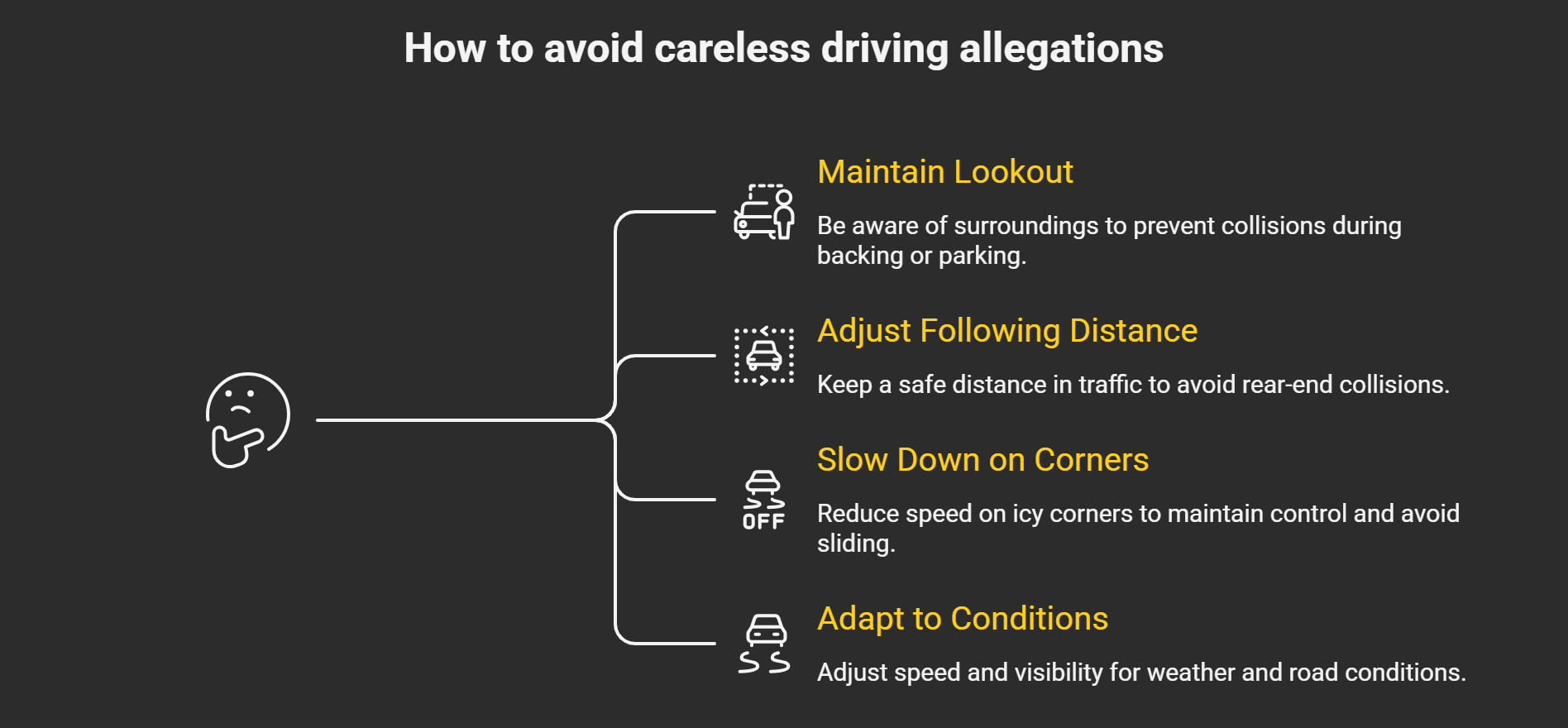
Poor lookout or rushed backing (hitting a parked vehicle, a bollard, or another driver reversing out).
Following too closely in stop-and-go winter traffic and tapping a bumper.
Turning too fast on an icy residential corner and sliding into another lane or curb.
Failure to adjust for conditions (speed for the conditions, visibility, stopping distance), especially in slushy lots or during freezing rain.
A key point: careless driving charges are frequently laid after the fact, based on collision reporting and statements, not because an officer witnessed the moment. XPolice notes that careless driving charges are “usually given to drivers involved in an accident where a police officer was not present to witness” what led to the collision. (XPolice)
Penalties and record impact
For standard careless driving (not involving bodily harm or death), the Highway Traffic Act sets a range that includes a fine of $400 to $2,000, possible jail up to six months, and a possible licence suspension up to two years. (CanLII)
Demerit points are separate from the court penalty, but they matter for your driving record. Ontario’s demerit point system lists careless driving as a 6-point offence. (Ontario)
If bodily harm or death is alleged, the penalties become dramatically higher, with a higher fine range and possible longer suspension. (CanLII)
For related reading on XPolice’s site, see: Fight Careless Driving Charges & Tickets Ontario. (XPolice)
Fail to remain Ontario meaning: what you are legally expected to do after a collision
“Fail to remain” is Ontario shorthand for a duty that applies when you are directly or indirectly involved in an accident. Under section 200 of the Highway Traffic Act, the person in charge of the vehicle must:
- Remain at or immediately return to the scene
- Render all possible assistance
- Provide identifying information in writing when requested (name, address, driver’s licence details, insurance, registered owner, permit number) (CanLII)
This is why the common “I panicked and left” story can turn into a serious allegation. It is not only about whether you caused the collision. It is about whether you handled the aftermath properly.
XPolice’s explainer frames it clearly: failing to remain is a provincial offence under section 200, and drivers are expected to remain/return, exchange particulars, and assist injured people. (XPolice)
Penalties for fail to remain
Under the Highway Traffic Act penalty section for s.200, a conviction can involve a fine of $400 to $2,000, possible jail up to six months, and a possible licence suspension up to two years. (CanLII)
Ontario’s demerit point guidance lists failing to remain at the scene of a collision as a 7-point offence. (Ontario)
For more detail, see: What “Failing to Remain” Means in Ontario and Fight Failing to Remain Charges. (XPolice)
When “fail to remain” crosses into Criminal Code territory
Not every leaving-the-scene situation stays provincial. Depending on the facts (injury, intent, other aggravating factors), police may consider Criminal Code allegations. XPolice notes the Criminal Code offence (“failure to stop at the scene of an accident”) carries much more severe consequences. (XPolice)
How misunderstandings happen in parking-lot and winter collisions
A lot of “fail to remain” allegations start as misunderstandings, not movie-style hit-and-runs. Examples:
You bump a car, do not see obvious damage, and leave. The other driver later finds a scrape and reports it.
You stop, but the other driver pulls away and you assume it is “fine,” without exchanging full details.
You move your vehicle out of a drive lane (often the right choice for safety), but the other driver interprets it as “leaving.”
You are in a multi-car lot situation and do not realize you made contact with something (a parked car, a low pole, a cart corral).
The pattern is consistent: stress plus uncertainty leads to incomplete steps at the scene. That is where “fail to remain Ontario meaning” becomes practical, not theoretical.
What to do immediately after a winter or spring thaw collision
This is not legal advice, but these steps reduce the risk of a minor incident turning into a major allegation.
First, stop and make the scene safe. If you can, move out of traffic while staying nearby and visible.
Second, exchange the basics. At minimum: names, phone numbers, driver’s licence, plate, insurance details, and photos of the vehicles and the location.
Third, document before emotions take over. Take wide shots (where the cars were), close-ups of any damage, and photos of the conditions (ice, slush, poor lighting). If there are witnesses, get contact info.
Fourth, understand reporting expectations. As of January 1, 2025, Ontario’s police reporting threshold for property-damage-only collisions is commonly communicated as $5,000 combined damage, with reporting typically directed through collision reporting centres (and processes vary by region). (Toronto Police Service)
Even if damage looks “minor,” there can be exceptions, and you still need to exchange information and remain/return as required under s.200. (CanLII)
Why paying immediately can backfire
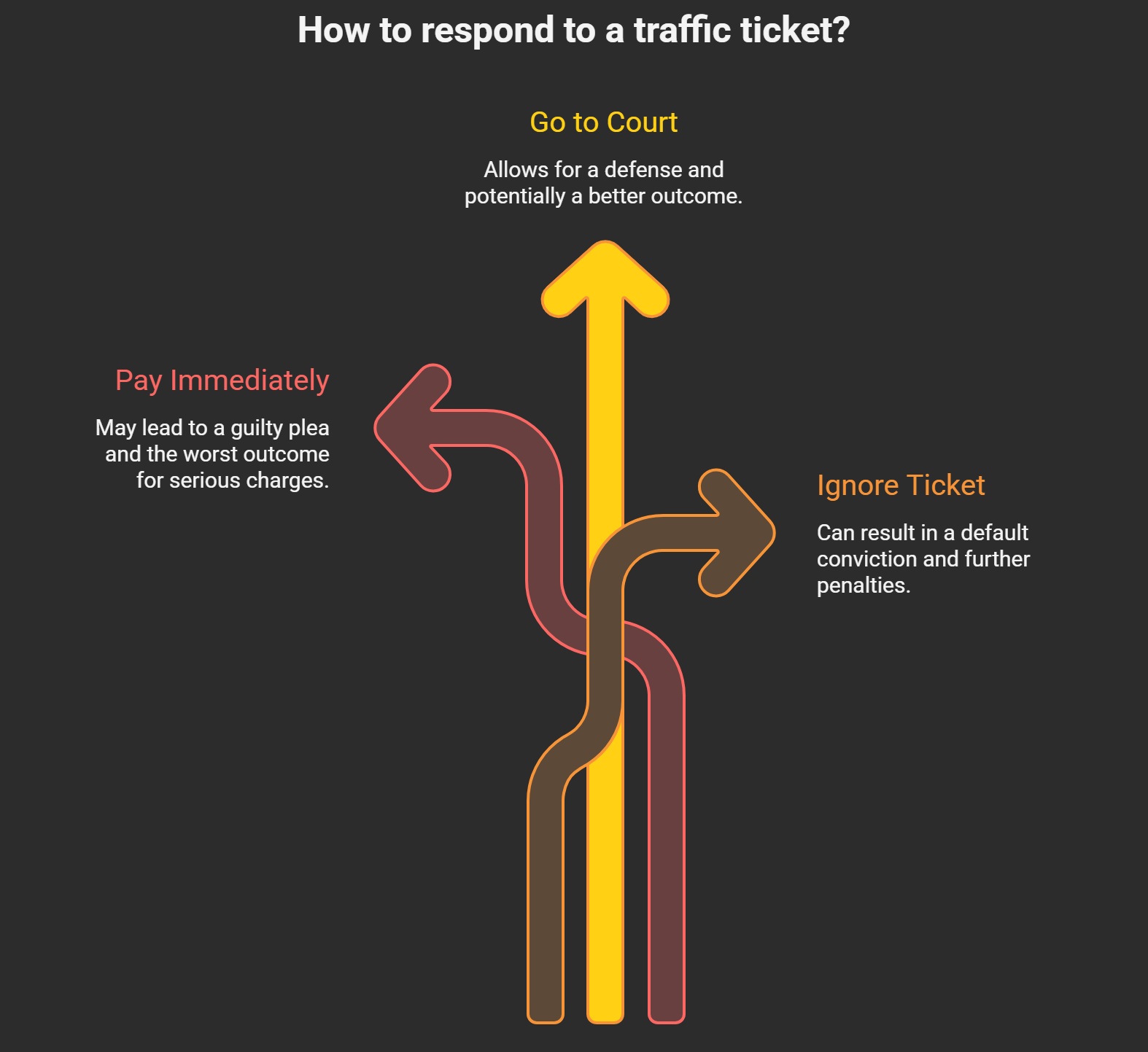
Many drivers treat tickets like invoices: pay it, move on. For serious accident-related charges, that approach can lock in the worst outcome.
XPolice explicitly warns that paying instead of going to court is pleading guilty. (XPolice)
And if you ignore a ticket entirely, you can be convicted by default; XPolice notes Ontario tickets must be responded to within the timeframe on the ticket (often 15 days for Part I tickets), or the court can enter a default conviction. (XPolice)
If you want a clean explanation of demerit points versus convictions (and why insurers care about convictions), these are useful references:
Demerit Points (XPolice)
How Long Do Driving Violations Stay on Your Record in Ontario? (XPolice)
The bottom line
Spring thaw fender-benders feel small because they often happen at low speed and in parking lots. Ontario law does not always treat them as small. Careless driving can apply in parking lots and garages, not just on public roads. (CanLII) Fail to remain is about whether you stayed, helped if needed, and properly exchanged information, even if the collision seemed minor. (CanLII)
If a collision leads to a careless driving allegation or a fail to remain allegation, the most important move is to avoid rushing into a guilty plea before you understand the consequences and your options.