
The ticket was written in June. Or July, on a shoulder somewhere north of Barrie, in a conversation that lasted four minutes.
You did not pay it, which was the right decision. You checked a box on the back, mailed it in, and then nothing happened for eleven weeks and you mostly stopped thinking about it.
Now there is an envelope on the counter with a date on it. A real date, in a real courthouse, in a city you may not have been to. It is in three weeks. It is on a Tuesday, in the middle of your workday.
Almost every driver who reaches this point knows one thing about what happens next: not much. They know there is a courtroom, and a prosecutor, and a decision to make about a deal they have not been offered yet.
Let us fix that. Here is what the notice means, what happens in the room, what the prosecutor can and cannot do, and where the actual leverage in your file is hiding.
Why is your summer ticket only surfacing now?
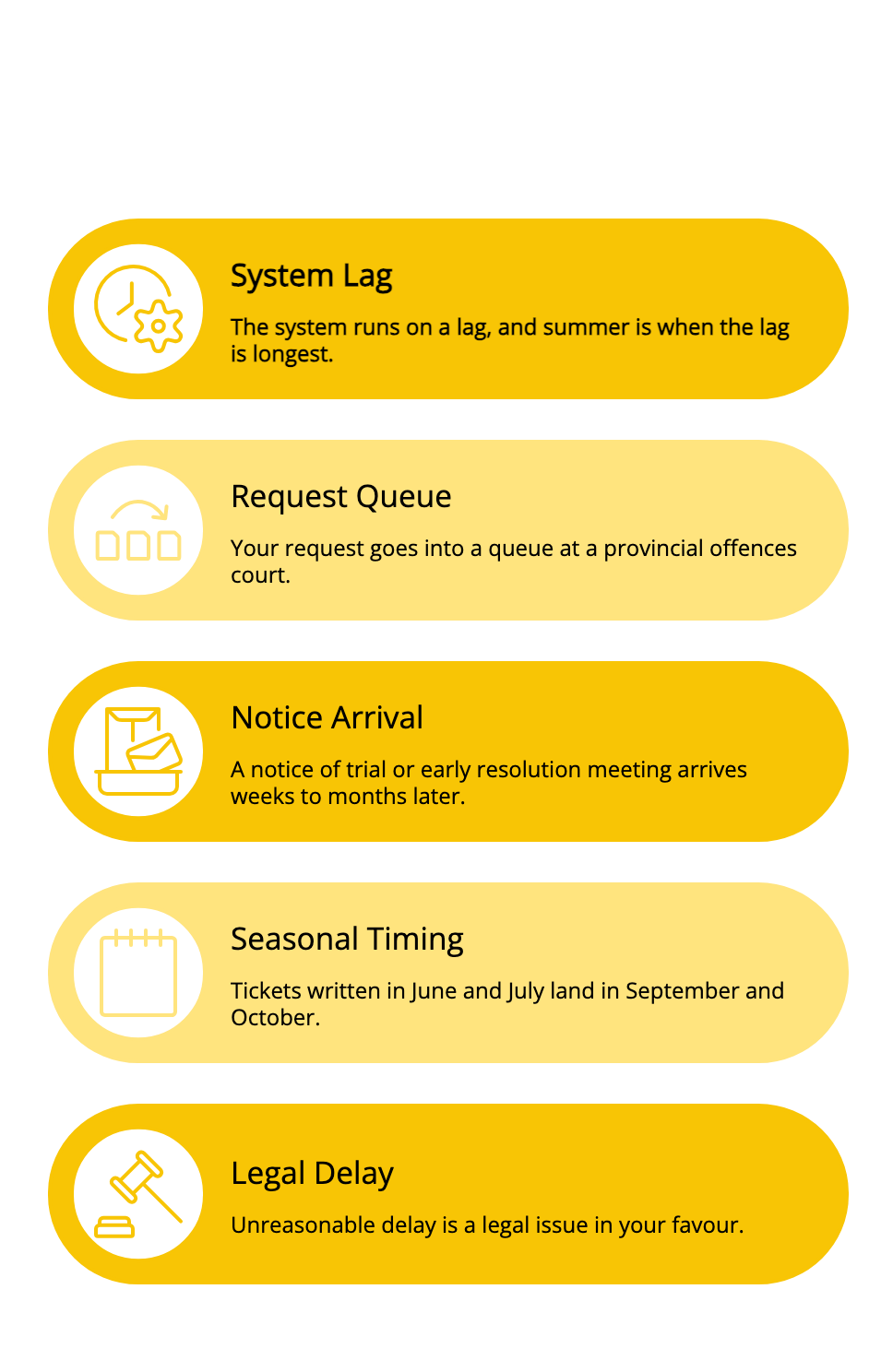
Because the system runs on a lag, and summer is when the lag is longest.
When you selected an option on the back of your offence notice, your request went into a queue at a provincial offences court. Depending on the jurisdiction and the backlog, a notice of trial or a notice of early resolution meeting arrives anywhere from a few weeks to several months later.
Tickets written across June and July land in September and October. This is not a coincidence, and it is not a delay tactic. It is simply how the calendar works.
There is a strategic point buried in that lag. A matter must proceed within a reasonable time. Where delay becomes unreasonable, that is a legal issue in your favour, not the court’s. Most self-represented drivers never raise it because they do not know it exists.
What is disclosure and why does everything depend on it?
Disclosure is the evidence the prosecution has against you, and you are entitled to see it.
On a speeding ticket, disclosure typically includes the officer’s notes, the certificate of offence, records for the speed measurement device, and the officer’s training and certification records on that device. On other charges it can include witness statements, collision reports, video, and more.
Requesting it is a step, not a formality. The request goes to a specific office, in a specific format, and the process is not uniform across Ontario. Some courts use online forms. Some use email. Some prosecutors’ offices have a dedicated disclosure address and a required file reference.
Here is why it matters more than anything else in this article.
You cannot evaluate an offer without knowing what the case against you actually is. A driver who walks into a meeting with a prosecutor having never read the officer’s notes is negotiating blind. They will accept a deal that sounds reasonable because they have no basis on which to judge whether it is.
A driver whose representative has read the notes and found that the officer recorded the wrong direction of travel, or failed to note the device test, or wrote the certificate of offence in a way that does not match what happened, is not negotiating at all. They are asking for a withdrawal.
The whole file turns on this. That is why the first thing we do on any matter is request disclosure.
What actually happens at an early resolution meeting?
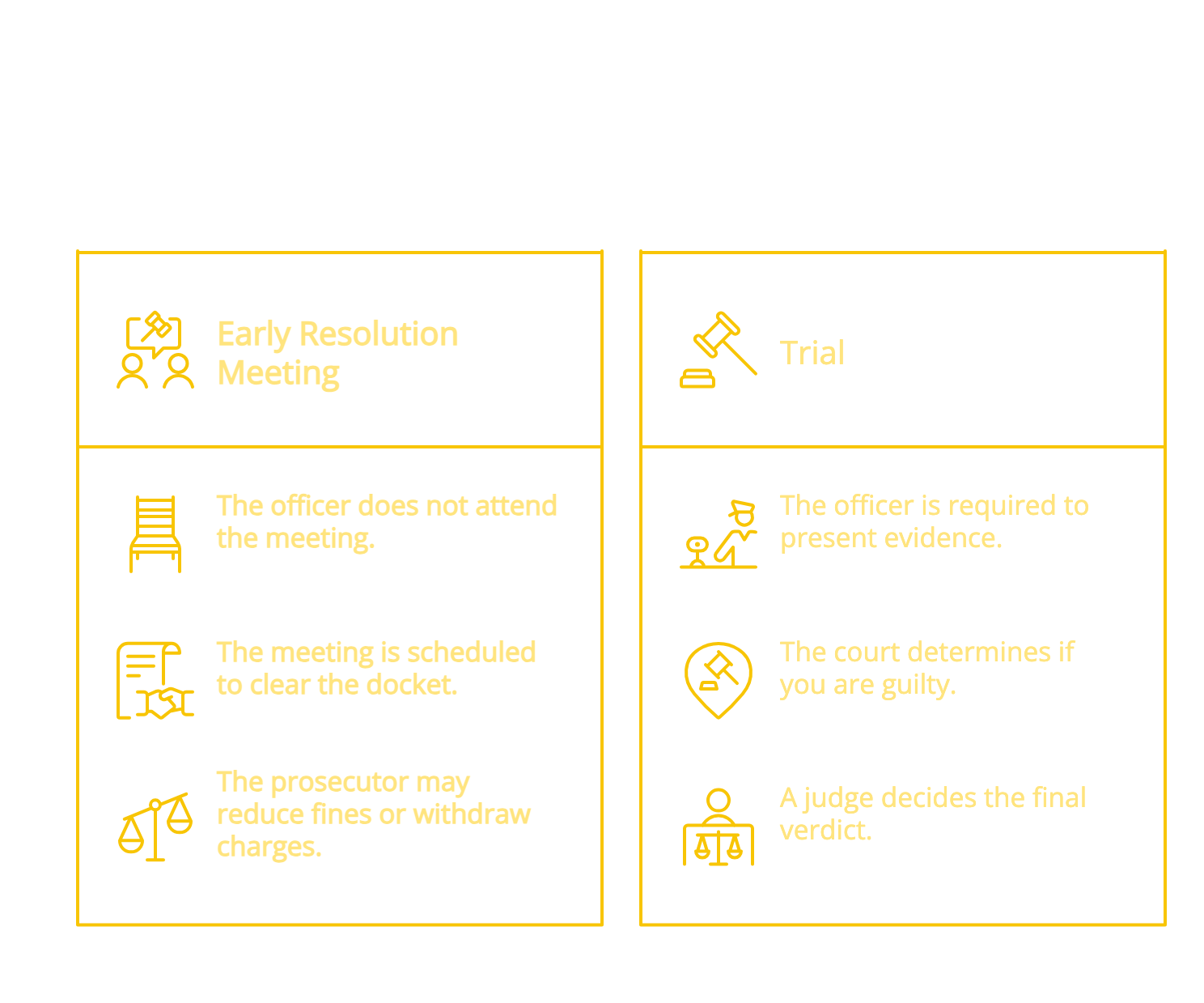
An early resolution meeting is a scheduled discussion with a provincial prosecutor. It is not a trial. It is not a hearing. Nobody decides your guilt.
The officer does not attend. That single fact defines the meeting.
The prosecutor reviews the file, considers your record and your circumstances, and may offer something. What a prosecutor has discretion to do:
- Reduce the fine
- Amend the charge to a lesser offence
- Reduce or eliminate the demerit points attached to the charge
- Grant additional time to pay
- Withdraw the charge entirely
That last one is real, and it is what everyone forgets. A prosecutor can withdraw a charge, and prosecutors do withdraw charges, when the evidence has a problem. The problem has to be identified and put in front of them, which brings us back to disclosure.
If no resolution is reached, you can still proceed to trial. What is said in that meeting is a negotiation, not testimony.
But understand what you are walking into. The default assumption of an early resolution meeting is that you will plead guilty to something. The court schedules them because they clear the docket. A driver who arrives with nothing to say beyond “I have a clean record and I need my licence for work” is asking for mercy, and mercy comes in the form of a conviction with a smaller number attached.
What happens at a trial?
A trial is a full evidentiary proceeding. You plead not guilty and the prosecution has to prove the charge.
The officer must attend and testify under oath. You or your representative cross-examine. The evidence is tested. A justice of the peace decides.
And if the officer does not appear, the charge can be dismissed outright.
That possibility does not exist at an early resolution meeting, because the officer was never coming. It is the single largest structural difference between the two paths, and it is almost never explained to drivers by the people steering them toward the meeting.
Trials take longer. Trial dates can be weeks or many months out depending on the courthouse. That delay is not always bad for you.
What can a prosecutor actually offer, and why is a reduction not a win?
Here is the thing the industry does not want to say out loud.
Your insurance company does not rate demerit points. It rates convictions.
When a prosecutor offers to amend your charge from speeding 25 over to speeding 15 over, what has changed is the number of demerit points and the size of the fine. What has not changed is that a conviction is going onto your driving abstract, where your insurer will find it at renewal and rate you accordingly.
The driver walks out of the courthouse relieved. Three months later the premium moves anyway, and they cannot understand why.
A reduction is a real thing worth having when it is the best available outcome. It is not the same thing as a win, and any firm that presents it as one is telling you a comfortable story.
A withdrawal leaves nothing. A dismissal leaves nothing. Those are wins.
We are not just interested in reducing your charges. Our goal is to beat them. You can read more about why drivers choose xpolice and what we actually do differently.
What “we go to court for you so you don’t have to” really means
It is not a slogan. It is a description of the service, and it is worth being precise about.
A licensed paralegal is authorized to represent you in Ontario’s provincial offences courts. That means you do not attend. Not the early resolution meeting, not the trial, not the adjournment. You do not take a day off work. You do not drive to a courthouse in a city you have never been to and stand in a hallway waiting for your name.
We file the request. We chase the disclosure. We read the notes. We deal with the prosecutor. We appear, and we cross-examine, and we argue the legal issues, including delay.
That is the difference between a firm that shows up to plead you down and a firm that shows up to win. Both of them are in that courthouse on Tuesday. Only one of them read the disclosure first.
See exactly how we work, from the first call through to resolution.
What should you do before that date?
Do not accept anything before disclosure has been reviewed. Not the offer over the phone, not the offer in the hallway.
Do not miss the date. Failing to appear at a trial or a scheduled meeting generally means being convicted in your absence.
Do not go alone if the charge matters. And for almost every driver, it matters more than the fine on the ticket suggests.
Call us before that Tuesday.
How XPolice can help
XPolice has been defending Ontario drivers since 2003. Our team is licensed paralegals and former police officers with more than 120 years of combined experience. Some of the people who read your disclosure spent careers writing the notes they are now reading, which is a meaningful advantage when the question is whether a file was built properly or built quickly.
We handle every charge under the Highway Traffic Act that we fight every day, from speeding to careless driving to stunt driving. We request the disclosure, we test it, and we go to court so that you do not have to.
Call before you pay. 1-888-XPOLICE (1-888-976-5423). Free consultation, no obligation.
Contact us today, before your court date decides things for you.
Frequently Asked Questions
What is the difference between an early resolution meeting and a trial in Ontario?
An early resolution meeting is a negotiation with a provincial prosecutor. The officer does not attend, no evidence is tested, and no one decides your guilt. The prosecutor may reduce the fine, amend the charge, reduce demerit points, or withdraw the charge entirely. A trial is a full evidentiary hearing where the officer must attend and testify, your representative cross-examines, and a justice of the peace decides. If the officer fails to appear at trial, the charge can be dismissed.
Do I have to attend traffic court myself in Ontario?
No. A licensed paralegal is authorized to represent you in Ontario’s provincial offences courts, which means they attend in your place. You do not need to take time off work, travel to the courthouse, or appear before a justice of the peace. This applies to early resolution meetings, trials, and adjournments alike.
Should I request disclosure before my court date?
Always. Disclosure is the evidence against you, and it commonly includes the officer’s notes, the certificate of offence, and records showing the speed measurement device was tested and the officer was certified to use it. Without reading it, you cannot tell whether an offer from the prosecutor is generous or whether the charge should have been withdrawn. Requesting disclosure is also not uniform across Ontario, so the process depends on the court and the prosecuting office.