

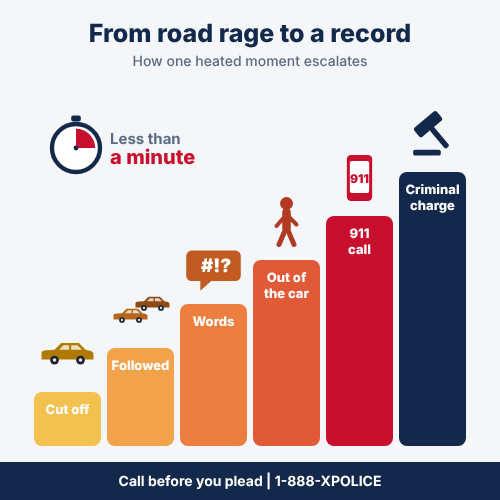
Someone cuts you off on the highway. They brake hard in front of you. They follow you into a plaza parking lot. Words are exchanged. Somebody gets out of their car.
The whole thing takes less than a minute. Then someone calls the police.
Road rage incidents start as traffic problems. They end as criminal cases. A driver who has never been in trouble can walk away from one heated moment facing an assault charge, strict release conditions, and a real chance of a criminal record.
In this post, you will learn what charges can come out of road rage, why they are far more serious than a traffic ticket, what happens after you are charged, and how these cases can be resolved.
What charges can come out of a road rage incident?
It depends on what happened. The most common charges include:
- Assault. Intentionally applying force to someone without their consent can be assault. A shove, a grab, or knocking a phone out of someone’s hand can qualify. In some situations, a threatening gesture can too.
- Uttering threats. Saying you will hurt someone or damage their property can lead to this charge, even if nothing physical happened.
- Mischief. Kicking a door, smashing a mirror, or keying a car can lead to a mischief charge.
- Highway Traffic Act charges. Tailgating, unsafe lane changes, or careless driving can be charged alongside the criminal offences. Those convictions carry their own insurance consequences.
When the vehicle itself is used aggressively, the charges become much more serious. Brake-checking, forcing a car off the road, or swerving at someone can lead to a charge of dangerous driving, or even assault with a weapon. Those cases need a lawyer, and they need one quickly.
Why is this more serious than a traffic ticket?
A traffic ticket is a provincial offence. It can raise your insurance and cost you demerit points. It does not create a criminal record.
A road rage assault charge is different. It is a criminal charge under the Criminal Code of Canada. If it ends in a conviction, you have a criminal record.
That record can affect:
- Your job, especially if you drive for work or need a police record check.
- Travel, including entry into the United States.
- Immigration status, if you are not a Canadian citizen.
- Future cases. A prior record changes how the Crown and the courts treat you next time.
The stakes are also immediate. Criminal charges usually come with release conditions that apply the moment you walk out of the station.

What happens after you’re charged?
Here is what the process usually looks like.
- Release with conditions. Your release paperwork will list conditions. These commonly include no contact with the other driver and staying away from certain places. Breaking a condition is a new criminal charge.
- Fingerprints and photos. You may be required to attend on a set date. Do not miss it.
- First appearance. Your case begins and the Crown provides disclosure.
- Disclosure review. This is where the evidence gets tested. In road rage cases, disclosure often includes dashcam footage, 911 calls, witness statements, and security video.
- Resolution or trial.
Road rage cases often come down to competing stories. Two drivers. Two versions of events. Both believe they were the victim. The evidence in disclosure is often what decides which version holds up.
Is there a way out without a criminal record?
In many cases, yes.
Depending on the facts, outcomes can include:
- Withdrawal, if the evidence does not support the charge.
- A peace bond, where the charge is withdrawn and you agree to keep the peace and follow conditions for a period of time. A peace bond is not a criminal conviction.
- Diversion, available in some courthouses for first-time offenders.
- A discharge, where you are found guilty but not convicted.
- Acquittal at trial, including cases where self-defence applies.
Self-defence matters in road rage cases. If the other driver was the aggressor and you acted to protect yourself, that can be a complete defence. It depends heavily on the evidence, which is one more reason to get advice before you say anything.
How do you protect yourself the next time it happens?
The best road rage case is the one that never starts.
- Stay in your car with the doors locked.
- Do not follow another driver. If someone follows you, drive to a police station or a busy, well-lit public place.
- Do not engage. No gestures, no honking back, no words through the window.
- Call 911 if you feel threatened. Being the first caller often matters.
- Use a dashcam. Footage protects you better than any argument.
- Do not post the video online. Share it with your representative, not social media.
If police stop you afterward, know your rights at a roadside stop. Stay calm. Provide your documents. Say you want to speak with a legal representative before giving a statement.
Can XPolice defend a road rage charge?
Often, yes. Licensed paralegals in Ontario can defend certain criminal charges when the Crown proceeds by summary conviction. Common assault, uttering threats, and mischief under $5,000 can fall within that scope.
Some road rage charges fall outside it, including dangerous driving and cases the Crown prosecutes by indictment. If your case needs a lawyer, we will tell you right away and make sure you get the right help. You can review the criminal charges we defend on our website.
How XPolice can help
Our team includes former police officers who have responded to road rage calls. We know how these investigations unfold, and how quickly a first impression at the scene can harden into a charge.
When you call about assault charges or other charges from a road rage incident, we review your release conditions, request disclosure, and look closely at video, 911 recordings, and witness statements. We pursue withdrawal, a peace bond, or another outcome that keeps a criminal record out of your life wherever possible.
The bottom line
A few seconds of anger can create years of consequences.
- Road rage can lead to assault, threats, or mischief charges.
- These are criminal charges, and a conviction means a criminal record.
- Many cases can be resolved without a conviction when the evidence is carefully reviewed.
We tell every driver to Call Before You Pay. After a road rage charge, the same rule means call before you plead. Do not talk about the incident, and do not plead guilty before you get advice. Reach XPolice at 1-888-XPOLICE (1-888-976-5423) for a free consultation.
Frequently asked questions
Can I be charged with assault if I never touched the other driver?
Yes, in some situations. A threatening act or gesture can be assault if it causes someone to reasonably believe force is about to be used. Uttering threats is also a separate charge.
Will a road rage charge affect my driver’s licence?
A criminal assault charge does not usually suspend your licence on its own. But Highway Traffic Act charges laid at the same time, or a dangerous driving charge, can.
Is a peace bond a criminal record?
No. A peace bond is not a conviction. It is an agreement to follow conditions, and the related charge is usually withdrawn.